Resort hotel · New Paltz, New York · Built 1869–1902 (oldest surviving part 1879)
Mohonk Mountain House
Listed on the National Register as Lake Mohonk Mountain House Complex
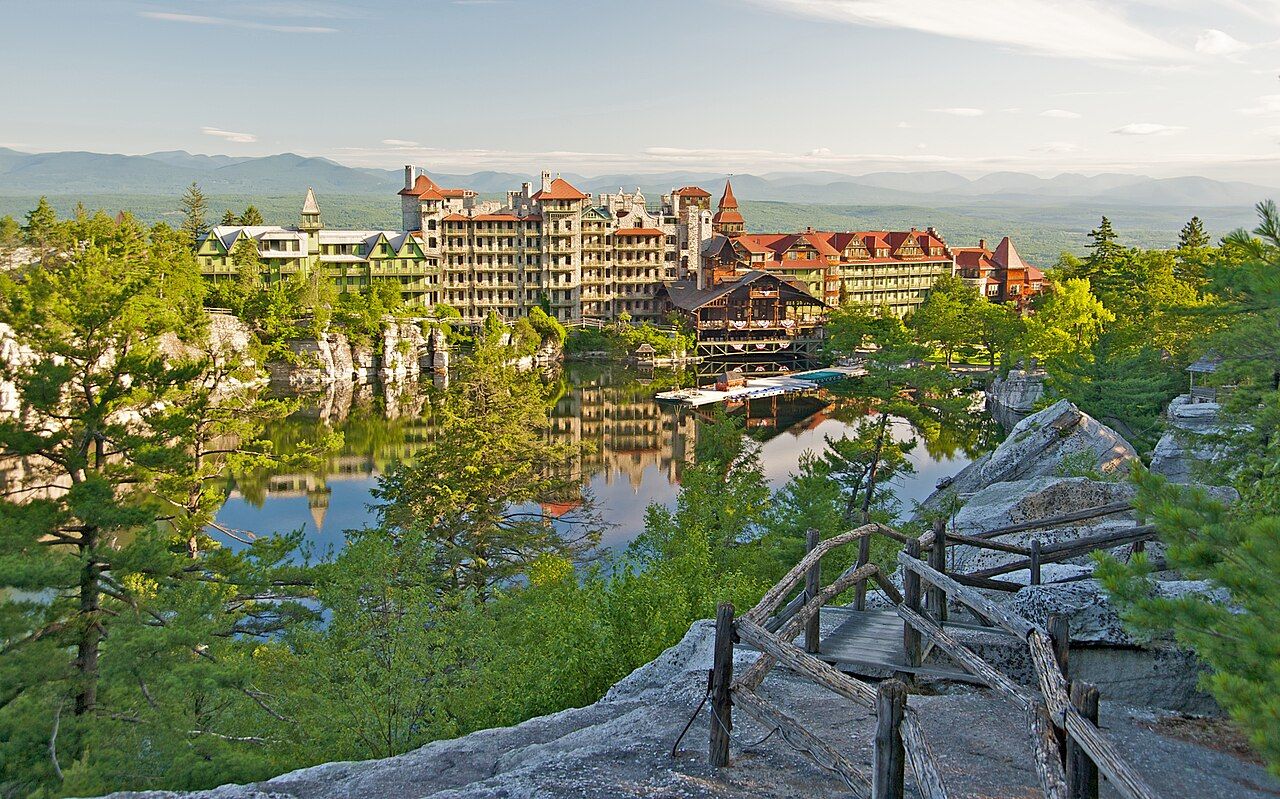
A seven-story, eighth-of-a-mile-long Victorian resort on a glacial lake atop the Shawangunk Ridge, grown from a small tavern the Quaker Smiley twins bought in 1869 and still owned by their family.
History
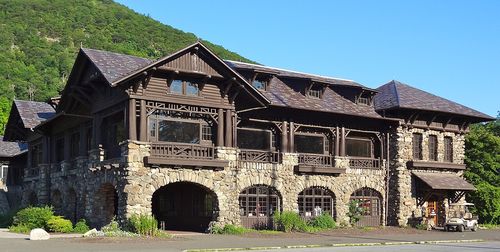
In 1869 Albert Smiley, a Quaker schoolmaster from Providence, visited a small tavern on a lake on the Shawangunk Ridge and was taken enough with the place to buy it, with his twin brother Alfred, as a quiet retreat for family and like-minded friends. Its popularity forced one enlargement after another. The oldest part still standing is the four-story Rock Building of 1879. Napoleon LeBrun & Sons, later known for the Metropolitan Life tower, designed the Central Building in 1887–88 and the Grove buildings with the dining room a few years later; James E. Ware added the parlor wing and the seven-story Stone Building, finished in sections in 1899 and 1902. Daniel Smiley had a strong hand in all of it.
The family's Quaker convictions shaped the resort: no liquor, plenty of fresh air, and the surrounding mountains treated as part of the attraction. The Smileys extended a 280-acre start into some 7,500 acres of gardens, carriage roads and trails, and managed much of it as an experiment in conservation and outdoor education. In 1963 they placed most of the land in a trust that became the Mohonk Preserve.
Mohonk also became a meeting ground for reform. Albert Smiley, a member of the federal Board of Indian Commissioners, hosted annual conferences on Indian policy from 1883, and from 1895 the Lake Mohonk Conferences on International Arbitration, which helped build support for the Permanent Court of Arbitration at The Hague; both series ran until about the First World War. In 1890, at Rutherford B. Hayes's urging, Smiley also convened a conference on the condition of Black Americans. Guests over the years included Andrew Carnegie, John Burroughs and Presidents Hayes, Chester A. Arthur and Theodore Roosevelt. The hotel was designated a National Historic Landmark in 1986.
“The result is a hodge-podge of roofs, wall surfaces, chimneys, and balconies that produce a picturesque silhouette against the still mountain lake.”
Architecture
The hotel is a chain of connected buildings more than 770 feet long, stepping from three to seven stories as it follows the rock ledge along the lake's northwest shore. Walls change from clapboard to shingle to rough stone, and the roofline is a crowded run of gables, towers, dormers and chimneys; the nomination counts 151 fireplaces and 259 balconies. Ware's parlor wing, a frame chalet wrapped in deep verandas, is cantilevered over the water on steel trusses, and the three-story dining room is finished in yellow and white pine with long views of the mountains. Visitors move from one building to the next along a meandering path rather than a single corridor.
What to look for
- The 1879 Rock Building at the southwest end
- Parlor wing cantilevered over the lake
- Rustic cedar gazebos along the shore
- Sky Top tower on the cliffs across the lake
- Long, irregular roofline of gables and towers
Setting
The hotel sits on the northwest shore of Lake Mohonk, a narrow glacial lake about half a mile long in a cleft of the Shawangunk Ridge, west of New Paltz where the towns of New Paltz, Marbletown and Rochester meet. Sheer white conglomerate cliffs rise across the water, topped by the stone Sky Top memorial tower. Gazebos and summerhouses dot the lakeshore, and carriage roads and trails lead into the Mohonk Preserve.
Timeline
- 1869Albert and Alfred Smiley buy a small lakeside tavern
- 1879Rock Building completed
- 1883First Lake Mohonk Conference on Indian affairs
- 1887–1888Central Building by LeBrun & Sons
- 1895First conference on international arbitration
- 1899–1902Stone Building by James E. Ware
- 1986Designated a National Historic Landmark
Where sources differ
- The nomination dates Ware's parlor wing to both 1899 and 1901.
- Acreage figures differ: the nomination gives about 7,500 acres for the historic complex, while Wikipedia gives 1,325 acres for the hotel property after the transfer to the preserve.