Resort hotel · Dixville Notch, New Hampshire · Built 1874; enlarged 1895–1918
The Balsams
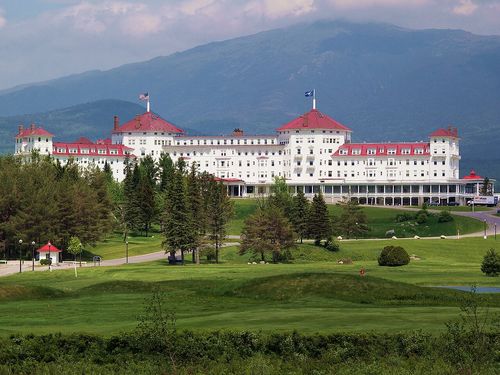
A sprawling White Mountains resort that grew from George Parsons's 1874 Dix House into a 400-guest hotel under Henry S. Hale, crowned by a fireproof stucco tower wing of 1916–18 beside Lake Gloriette.
History
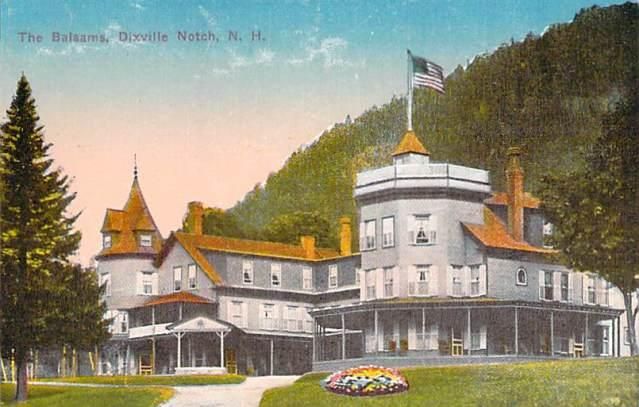
Railroads reached Colebrook, ten miles away, in 1870, and in 1874 George Parsons of Colebrook opened Dix House, a two-and-a-half-story inn for about fifty guests in the wild gap of Dixville Notch, named for the early landholder General John A. Dix. Parsons's widow enlarged it in 1892. Three years later it was bought by Henry S. Hale of Philadelphia, inventor of the reversible Pullman seat, who had come for sixteen summers to escape hay fever. Hale renamed it The Balsams and spent the next twenty years turning an inn into a self-contained resort. He wrapped the old house in porches and towers, added wings in 1906–12, dammed a stream to make Lake Gloriette, laid out trails, a deer park and fish hatcheries, bought sixteen farms to feed the kitchen, and brought in Donald Ross for the Panorama golf course. The climax was Hampshire House, opened in 1918 with John Philip Sousa playing, which raised capacity to about 400.
Losses in the First World War forced Hale to auction the hotel in 1922 to J.J. Lannin, owner of the Boston Red Sox, who started a daily airplane delivery of New York papers. Frank Doudera traded a Brooklyn hotel for it in 1927; two years later Lake Gloriette's dam burst and floodwaters wrecked much of downtown Colebrook. In 1954 Neil Tillotson, the latex manufacturer credited with the modern rubber balloon, bought the place, moved glove and balloon production into the old guest garage, opened it for winter in 1965, and made the hotel's Ballot Room the setting for Dixville Notch's midnight primary vote from 1960. The hotel closed in December 2011 after a sale, pending redevelopment.
“Like most New England examples, it achieved aesthetic impact not through architecturally stunning buildings, but through its immense size and spectacular setting.”
Architecture
The main hotel is a chain of white wooden wings, two and a half to three and a half stories high under red gabled and gambrel roofs, with corner turrets and octagonal towers. Parsons's 1874 house survives as the U-shaped core, recognizable by the round turret at its southwest corner and the Colonial Revival entry of about 1911. Hampshire House is different in kind: a five-story, stucco-clad, red-tiled wing by Chase R. Whitcher, punctuated by eight seven-story towers, Flemish gables and iron balconies in a Rhenish manner. The nomination calls it the first steel-frame, reinforced-concrete building in New Hampshire, built fireproof because so many wooden resort hotels had burned. Nearby are Hale's shingled Craftsman cottage, Beaver Lodge (1912), and a 1916 garage built for 200 cars.
What to look for
- Hampshire House's red-tiled towers and Flemish gables
- The round turret on the original 1874 Dix House core
- Lake Gloriette and the Moss Glen Brook waterfall
- Castellated stone arch at Beaver Lodge
- Dated 1902 boiler-house chimney
Setting
The hotel sits on the north side of Route 26 at the foot of the sheer rock walls of Dixville Notch, about ten miles east of Colebrook in the far north of the state. Lake Gloriette lies in front of it; Moss Glen Brook drops about sixty feet in a waterfall above the entrance drive before running into the lake. A castellated stone wall and arch front Beaver Lodge on the lake's north shore, and the ski slopes rise across the road.
Timeline
- 1874George Parsons opens Dix House
- 1895Henry S. Hale buys it and renames it The Balsams
- 1916–1918Hampshire House, staff dormitory and garage built
- 1922Hale auctions the hotel to J.J. Lannin
- 1954Neil Tillotson buys the property
- 1960First midnight primary vote in the Ballot Room
- 2011Hotel closes after a change of ownership
Where sources differ
- Wikipedia describes the original Dix House as a 25-room inn opened just after the Civil War; the nomination dates it to 1874 with room for fifty guests.
- Guest capacity figures in hotel brochures vary widely, as the nomination itself notes.
- Redevelopment plans reported by Wikipedia include demolishing and rebuilding the Dix House section; the building's future form is undecided.