Inn · Bethlehem, Pennsylvania · Built 1758–1760; enlarged 1826 and 1850s; restored after 1971
Sun Inn
Listed on the National Register as Moravian Sun Inn
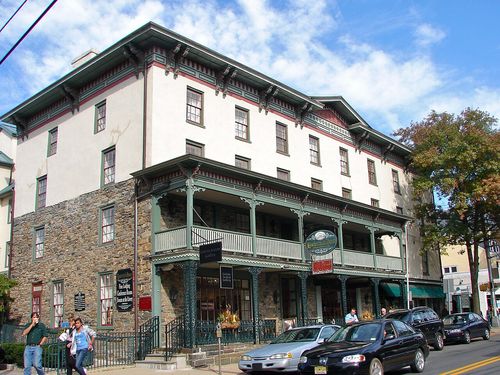
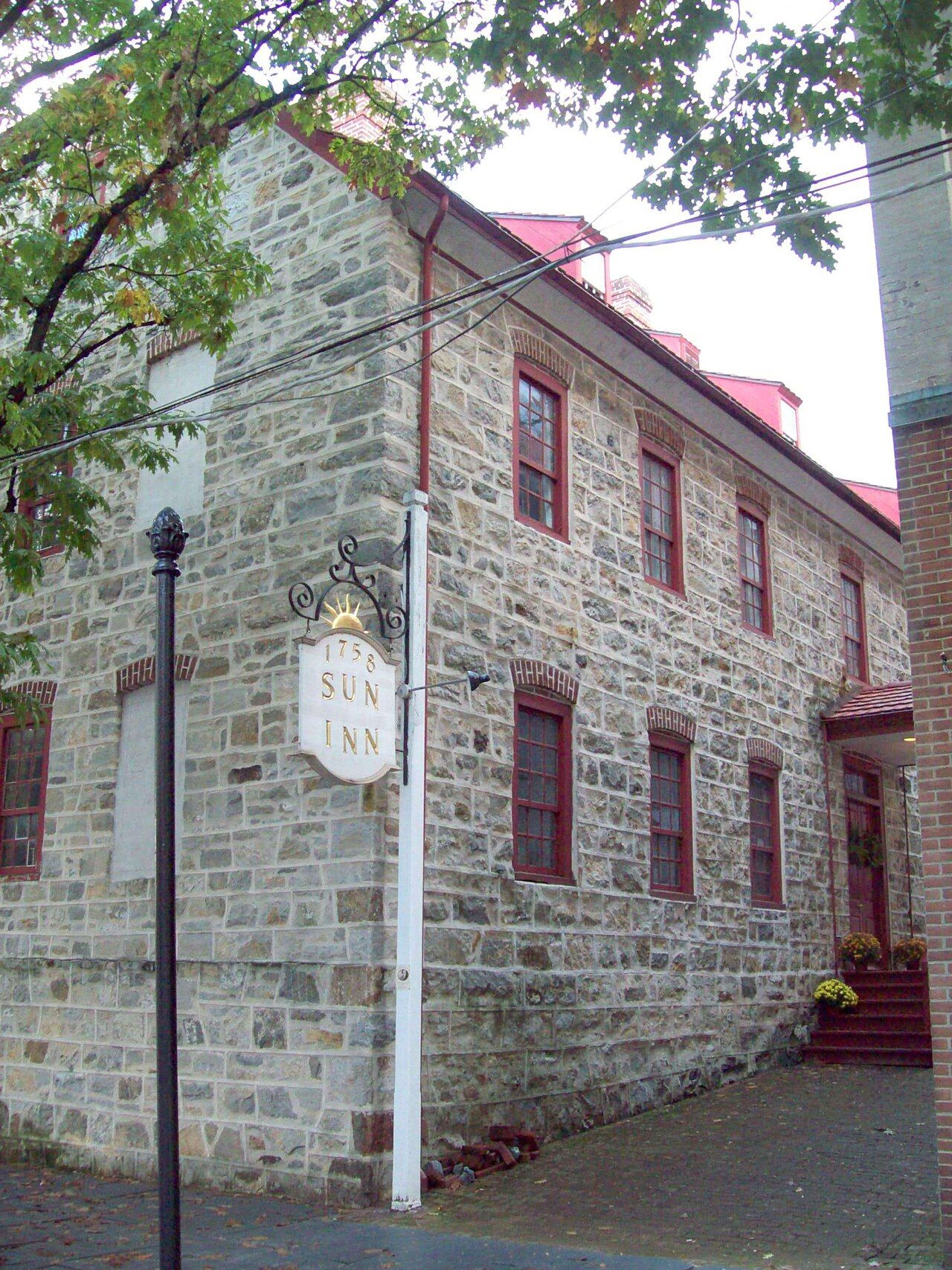
The limestone inn the Moravian community of Bethlehem built in 1758–60 to lodge outsiders, a Germanic-style colonial inn whose register filled with Revolutionary leaders, later buried under Victorian additions and restored.
History
Bethlehem was founded in 1741 as a communal Moravian settlement, and its farms and workshops, run collectively as the Economy, soon drew merchants and curious travelers on the road between the southern colonies and New England. The Brethren wanted a place to house and feed these outsiders that would also keep them at a proper distance from community life. Construction of the inn began in April 1758 and dragged on until March 1760; the first guests were received that September. It earned a reputation for its table and its Madeira, and a traveler in 1782 judged it the equal of the best large inns in England.
Because it stood on the main road north from Philadelphia, the inn's register, its Waste Book, reads like a roll of the Revolution: Governor John Penn and General Thomas Gage before the war, then George Washington, Alexander Hamilton, John Adams, John Hancock, Samuel Adams, Richard Henry Lee, Generals Gates, Greene, Knox and Benedict Arnold, and Baron von Steuben. Members of the Continental Congress lodged here in September 1777 after the British took Philadelphia, and after Brandywine some 900 army wagons were parked in the meadows behind it. In March 1799 John Fries and his armed followers came to the inn and forced the U.S. marshal to release prisoners held for refusing a federal house tax, an episode known as Fries's Rebellion. A third story went on in the nineteenth century, then a fourth floor and a large addition; a 1921 remodeling gutted the interior. The hotel closed in 1961, and the Sun Inn Preservation Association, formed in 1971, bought and restored it.
“The Sun Inn is the only known example of a colonial inn built in Germanic rather than Anglo-American style.”
Architecture
As first built, the inn was a two-story limestone block, 40 by 66 feet, under a steep roof with clipped (jerkinhead) ends, with two chimneys at the center in the German manner, herringbone-pattern doors and shed dormers. Thick-walled vaulted cellars lay beneath; on the main floor a long hall led past the innkeeper's counter to guest rooms and a private suite, and the attic was partitioned into rooms with alcoves under the eaves. The nomination called it the only known colonial inn built in a Germanic rather than Anglo-American style. Later floors, a flat roof and stucco hid this form until the restoration that followed the 1973 listing returned the building to its eighteenth-century appearance.
What to look for
- Steep roof with clipped gable ends
- Limestone walls of the restored 1758 block
- Nearby colonial Moravian buildings of the same masonry tradition
- Main Street's line of historic storefronts
Setting
The inn stands at 564 Main Street in the historic core of Bethlehem, a short walk from the stone Moravian community buildings of the eighteenth century: the Gemeinhaus, the Single Brethren's and Sisters' houses and Central Moravian Church. The meadows where Washington's wagon train was parked lay in the lowlands toward Monocacy Creek.
Timeline
- 1758Construction begins in April
- 1760First guests received in September
- 1777Continental Congress delegates lodge at the inn
- 1799Fries's Rebellion prisoners freed at the inn
- 1826Third story added
- 1961Inn closes as a hotel
- 1971Sun Inn Preservation Association formed
Where sources differ
- Wikipedia dates the third story to 1816 under Christian Jacob Wolle and the large enlargement to 1866; the nomination gives 1826 and the 1850s.
- Wikipedia describes the original roof as a mansard; the nomination describes a gable roof with truncated ends.
- The nomination says Lafayette recovered from his Brandywine wound at the inn; other accounts place his convalescence in a private Bethlehem house.
- The nomination's description reflects the building before restoration.