Mansion · Stockbridge, Massachusetts · Built 1893–1894
Wheatleigh
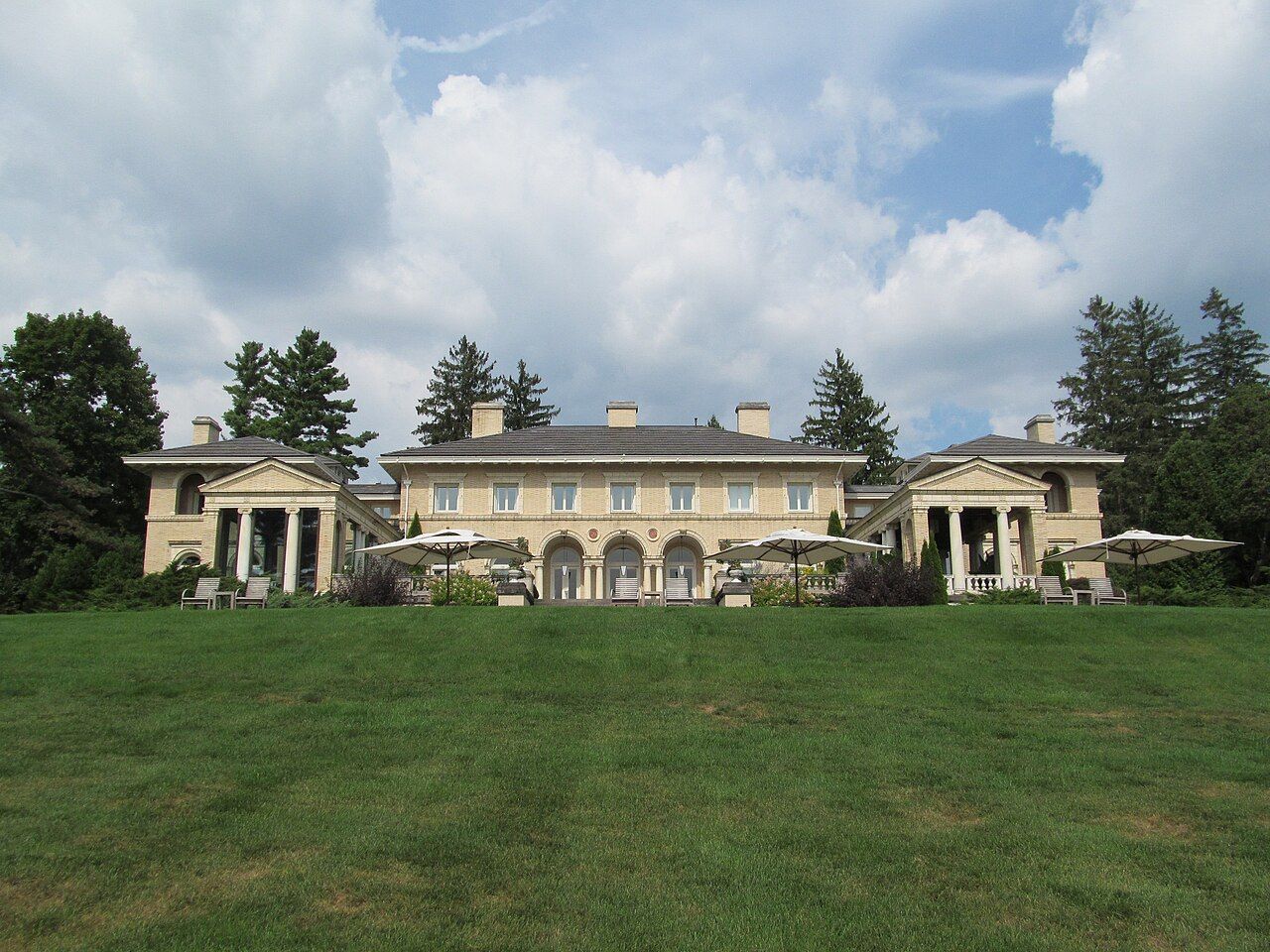
A buff-brick Italian villa that Peabody & Stearns designed in 1893 for New York financier Henry H. Cook above Stockbridge Bowl; one of the surviving Gilded Age Berkshire cottages, used as an inn from 1976.
History
Henry Harvey Cook had built the Erie Railroad's branch from Binghamton to Corning, presided over banks including the National Bank of North America, and collected the paintings and sculpture he later left to the Metropolitan Museum of Art. In 1892 he paid Gideon Northrop Smith $50,000 for 250 acres of undeveloped hill land in the northeast corner of Stockbridge, then in the thick of the Lenox–Stockbridge cottage boom that earned the district the name "Inland Newport." He named the estate for his family's ancestral home at Wheatley, England, and hired the Boston firm of Peabody & Stearns, with the Worcester contractors Cutting & Bishop. Begun in 1893, the place grew to a 33-room house, four greenhouses, a water tower, a ten-car garage, an icehouse, a barn and three gatehouses.
Cook died in 1905 and left Wheatleigh to his daughter Georgie, the wife of the Cuban-born Count Carlos de Heredia. From 1921 she lent the formal gardens to Trinity Church in Lenox for summer sunset vespers, a custom that lasted 24 years, and she helped pay for the Music Shed at neighboring Tanglewood. After her death in December 1946 her nieces sold the estate; the Boston Symphony Orchestra owned the house and about 21 acres from 1949 until 1957, while the rest of the land was sold off.
The owners who bought it in 1976 turned the house into an inn and restaurant. L. Linfield and Susan Simon acquired it in 1983 and ran it as a small luxury hotel; according to Wikipedia, hotel operations stopped in spring 2024 and the property was put up for sale.
“all interested agreed that the broad surfaces and horizontal lines found in an Italian Villa were best suited to the beautiful rolling country and the shores of the lake where the house was to be placed.”
Architecture
Peabody, the firm's Beaux-Arts-trained designer, assisted by the renderer Julius Schweinfurth, worked out a symmetrical U-shaped villa of buff Roman brick in Flemish bond with terra-cotta trim, two stories under low, overhanging slate hip roofs. The seven-bay west front faces the lake: three central round arches on paired Tuscan columns open onto a long tiled terrace reached by marble steps guarded by rampant lions, and small temple fronts mask the one-story hyphens. The east, garden side is looser, with a glass-and-iron canopy over the entrance, an open loggia above, tall stained-glass stair windows and a marble fountain of shells and dolphins in the forecourt. Charles McKim praised the house to Edith Wharton in 1897 as a successful modern adaptation of the type. The 100-foot octagonal water tower, stone below and clapboard above with a clock and cupola, is known locally as the Poodle Tower.
What to look for
- Triple arcade on paired Tuscan columns on the lake front
- Marble lions guarding the terrace steps
- Dolphin-and-shell fountain in the east forecourt
- The 100-foot "Poodle Tower" with its clock stage
- Brick gateposts along West Hawthorne Road
Setting
Wheatleigh crowns a wooded plateau in the northeast corner of Stockbridge, looking west over Stockbridge Bowl (Lake Mahkeenac), just south of Tanglewood on West Hawthorne Road. Only 22 of the original 250 acres remain with the house, but brick gateposts, walls and the tall water tower still mark the old estate. Lenox village lies a few miles north.
Timeline
- 1892Henry H. Cook buys 250 acres in Stockbridge
- 1893Peabody & Stearns begin the house
- 1905Cook dies; estate passes to Georgie Cook de Heredia
- 1921Gardens opened for Trinity Church sunset vespers
- 1949–1957Boston Symphony Orchestra owns the house
- 1976Opened as an inn and restaurant
- 1982Listed on the National Register
Where sources differ
- Wikipedia credits the grounds to Frederick Law Olmsted; the nomination describes formal landscaping but does not name a landscape designer.
- Wikipedia gives Cook's daughter's name as Gloria; the nomination calls her Georgie Bruce Cook de Heredia.
- The nomination says the heirs sold the estate immediately after 1946 but gives the purchase date as June 10, 1949.