Bed-and-breakfast · Waitsfield, Vermont · Built c. 1795; house c. 1835; barn enlarged 1895
Lareau Farm
Listed on the National Register as Lareau Farmstead
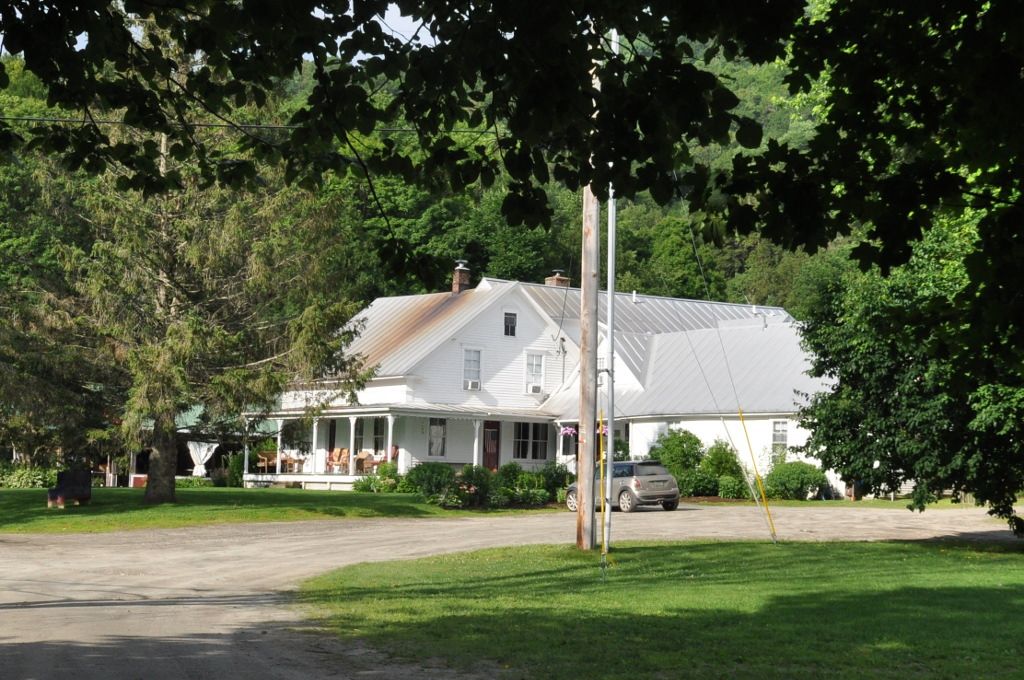
A connected Vermont farmstead on the Mad River, begun about 1795 by Waitsfield's first doctor, with a Greek Revival cape of about 1835 and a rare unmodernized 1895 gravity dairy barn; an inn since the 1980s.
History
Dr. Simeon Stoddard, born in Saybrook, Connecticut, in 1761, followed his friend Benjamin Wait from Windsor to the new town of Waitsfield in 1794 and became its first resident physician. About 1795 he built a small house and a 30-by-40-foot English barn on the west bank of the Mad River, beside one of the town's first roads, which became part of the Mad River Valley Turnpike in 1807. Like other professional men on the frontier he farmed as well, raising grain, flax and hay, served on the select board, and had twelve children with his wife Abiah. The couple lie in a small, overgrown family graveyard on the hill southwest of the farm. Around 1835 a new Greek Revival main house was built in front of Stoddard's, which became its rear wing.
Gideon Stoddard sold the place in 1863, ending three generations of family ownership. Pliny Lockwood, owner on and off from 1878 to 1917, followed the valley's turn to dairying: in 1895 he swung the old English barn ninety degrees and extended it seventy feet into a banked gravity barn, and he refitted the kitchen and a back room with butternut Italianate woodwork. Philippe and Fleurette Lareau bought the farm in 1940, gave it its name, and milked cows into the 1950s. Dan and Susan Easley bought it in 1984 and turned it into the Lareau Farm Inn for skiers coming to the valley, adding a rear wing with guest rooms about 1988. In 2001 George Schenk, who had been baking flatbread in the carriage barn, bought the property.
“Much of the original 1795 barn framing is extant in the enlarged structure, including marriage marks used by the builders to assemble the barn after bench fitting the connecting members.”
Architecture
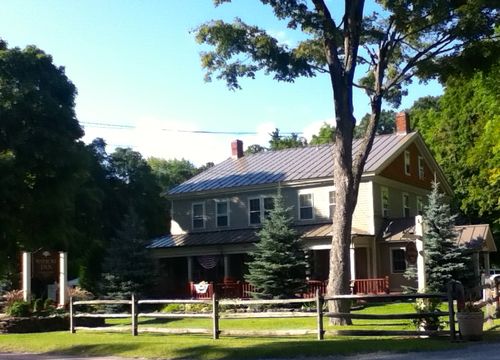
The farmhouse is a classic New England connected farm: a 30-foot-square, one-and-three-quarter-story main house with a high knee wall, wide corner pilasters with molded capitals and a stepped double frieze, linked through Stoddard's long 1795 wing to a horse and carriage barn. A flat-roofed porch on chamfered posts with scroll-sawn brackets wraps the front and north end. Inside are a center stair hall, horsehair plaster and wide pine floors. The dairy barn, now 40 by 100 feet, is the more important building: it kept its high drive, hay chutes and manure trapdoors because dairying ended before the bulk-tank rules of the 1960s forced changes. Joiners' marriage marks remain on its 1795 timbers.
What to look for
- Greek Revival corner pilasters and double frieze on the main house
- The long connected line of house, wing and carriage barn
- High drive into the 1895 gravity dairy barn
- Old Route 100 roadbed and covered-bridge abutment by the river
Setting
The farm stands on a terrace above the west bank of the Mad River, about a mile and a half south of Irasville and some 500 feet west of Vermont Route 100, which crosses the river at the property's corner. The old road bed still runs in front of the house and barn, ending at a stone abutment from a vanished covered bridge. Open hayfields surround the buildings, with wooded foothills of the Green Mountains rising on three sides.
Timeline
- 1794Dr. Simeon Stoddard settles in Waitsfield
- c. 1795Stoddard builds his house and English barn
- c. 1835Greek Revival main house added
- 1895Pliny Lockwood rebuilds the barn for dairying
- 1940Philippe and Fleurette Lareau buy the farm
- 1984Dan and Susan Easley buy it and begin the Lareau Farm Inn
- 2016Listed on the National Register
Where sources differ
- Wikipedia credits Pliny Lockwood with the horse barn; the nomination dates it to about 1865, before he bought the farm.
- Wikipedia says Stoddard arrived with Benjamin Wait; the nomination says Wait had settled five years earlier, in 1789.
- The early dates (c. 1795, c. 1835) rest on building evidence rather than documents.