Lodge · Bear Mountain (Stony Point), New York · Built 1914–1915
Bear Mountain Inn
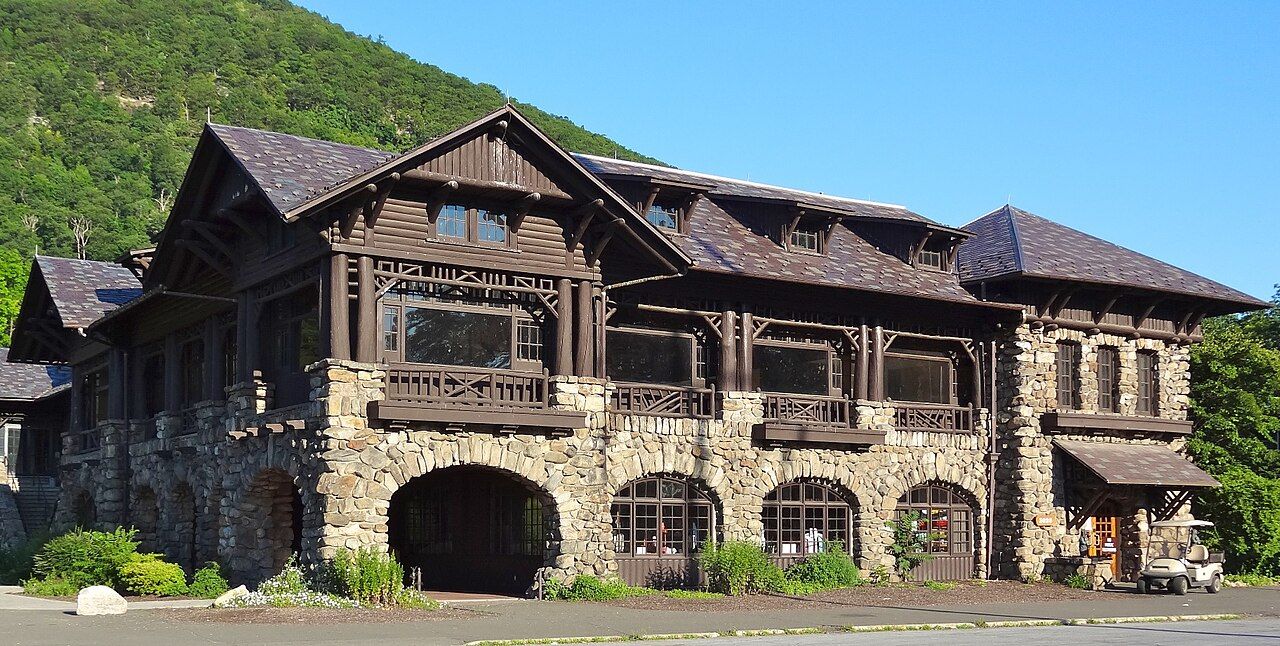
A 200-foot rustic lodge of fieldstone boulders and chestnut logs, opened in 1915 as an open-air restaurant for crowds at Bear Mountain State Park and one of the earliest large park lodges in the country.
History
Bear Mountain–Harriman State Park grew out of a fight over a prison. In 1908 the state planned to move Sing Sing to land above the Hudson near the Revolutionary forts Clinton and Montgomery; Mary Harriman, widow of the railroad man E.H. Harriman, offered 10,000 acres for a park in his memory on condition the prison go elsewhere, and the Palisades Interstate Park Commission opened the park in 1910. City people poured in by steamboat and train, 450,000 of them by 1914, and the commission's improvised lunch stands could not keep up. Its engineers, Ernest D. Bean and William A. Welch, wanted a building to rival private resorts, and in 1914 the commission hired the young New York firm of Tooker & Marsh, later known mostly for schools.
The inn was dedicated on June 1, 1915. Commission president George W. Perkins advertised its second floor as one great open balcony with no windows, and the ground-floor cafeteria opened through an unglazed stone arcade to the lawns. At first the commission put overnight guests up at hotels in Haverstraw and Highland Falls, but in 1922–23 it added steam heat, turned the third floor into rooms, and kept the inn open all winter as a base for skiing and skating. Early guests had to apply and supply references. Sports teams, among them the Brooklyn Dodgers, used it as a training base in the 1930s and 1940s, and in 1943 Madame Chiang Kai-shek stayed in one of its outlying lodges. Concessionaires ran it from 1941. After closing around 2005 for a long restoration, it reopened in 2012.
“The Bear Mountain Inn was one of the earliest rustic lodges built in a national or state park.”
Architecture
The inn is a symmetrical block 200 feet long and 80 feet wide under a slate hip roof, broken by cross-gabled pavilions and shed dormers. Its ground story is an arcade of huge uncoursed fieldstone boulders gathered from old walls on the park lands; above, walls of glass sit between heavy peeled chestnut posts, and whole logs, log brackets and slab siding fill the gables. The chestnut, cut on site, came from trees killed by the blight then sweeping the Northeast. Behind the rustic surfaces, floors and piers are reinforced concrete. Broad stone stairs climb the south front to the second floor, where the former dining room under exposed log rafters has a massive boulder chimney and an oversized round-arched fireplace.
What to look for
- Ground-floor arcade of giant fieldstone boulders
- Peeled chestnut log framing on the upper walls
- Twin stone stairways on the south front
- Boulder fireplace in the second-floor lounge
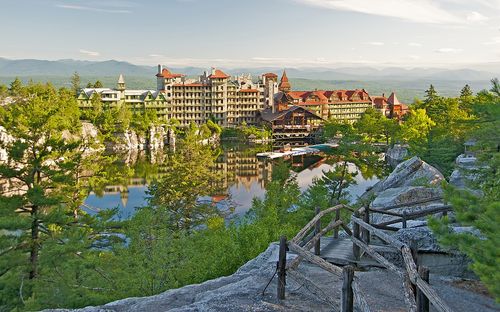
- Hessian Lake just north of the building
Setting
The inn sits on a plateau at the foot of Bear Mountain, on the west side of Seven Lakes Drive just south of U.S. 9W, about half a mile north of the Bear Mountain Bridge. Hessian Lake lies immediately to the north, with open playing fields to the south and the Hudson River gorge to the east. Stone guest lodges, Overlook Lodge and the Trailside Museums and Zoo are close by, and Perkins Memorial Drive climbs to the summit.
Timeline
- 1910Bear Mountain–Harriman State Park opens
- 1914Tooker & Marsh hired to design the inn
- 1915Inn dedicated on June 1
- 1922–1923Winterized; third floor converted to guest rooms
- 1941Operation turned over to a concessionaire
- 2002Listed on the National Register
- 2012Reopened after a six-year restoration
Where sources differ
- Wikipedia says the basic framework is steel; the nomination describes a reinforced-concrete structure with stone and log exterior walls.
- The story that Kate Smith wrote "When the Moon Comes Over the Mountain" at the inn is unconfirmed.