Mansion · New London, Connecticut · Built 1902
Lighthouse Inn
A stuccoed Mission-style summer house that William Ralph Emerson designed in 1902 for steel executive Charles S. Guthrie near Long Island Sound; it opened as the Lighthouse Inn in 1927.
History
Charles Strong Guthrie rose from modest beginnings to the presidency of Republic Iron and Steel, a company he helped assemble in 1899 alongside John W. "Bet-a-Million" Gates. He and his wife, Frances Amelia Lampson Guthrie, had been summering at the fashionable Pequot Colony in southern New London, and in 1901 they laid out a twelve-acre estate of their own on the shore. They hired the Boston architect William Ralph Emerson for the house and Olmsted Brothers for the grounds. Finished in 1902–03, the place was called Meadow Court after a six-acre wildflower meadow that ran down toward the Sound.
Guthrie died in 1906, aged 46. By 1920 his widow was summering on Long Island instead, and in 1925 she and two local partners began selling the estate off as house lots. The mansion itself survived and opened in 1927 as the Lighthouse Inn. It quickly became New London's setting for chamber concerts, civic dinners and parties around the June Yale–Harvard regatta, while families from across New England came for stays of several weeks. From 1929 to 1936 a private elementary school, the Pequot Day School, used rooms in the east wing and carriage house.
William and Albert Ronnick of Hartford bought the inn in 1945 and made it the region's leading dinner-and-dancing spot; the pianist Roger Williams played a full season there in 1951, and actors in local summer stock, Franchot Tone, Joan Crawford and Bette Davis among them, stayed as guests. A fire in 1979 gutted much of the upper floors. Albert Ronnick took the building back through foreclosure and spent years restoring it before losing it again in 1992.
“Within a short time after its 1927 opening, Lighthouse Inn established an excellent reputation as a restaurant and hotel.”
Architecture
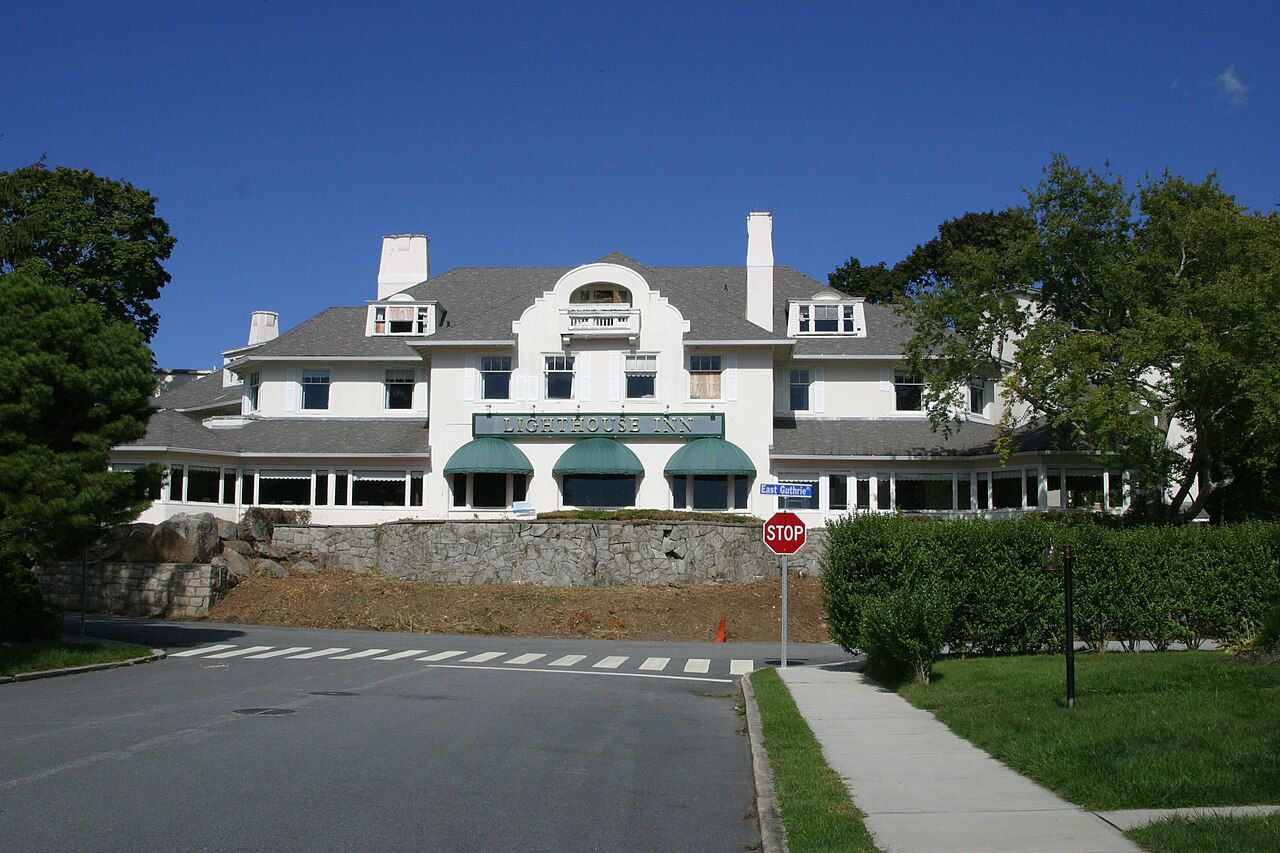
Emerson, remembered chiefly as an originator of the Shingle style, turned here to Spanish colonial sources late in his career; the nomination calls it his only known design of this kind. The two-story stucco house sits on a granite ashlar base under broad hipped roofs carried on small curved brackets. Wings angle out from the main block at 45 degrees and then turn back, framing a circular drive and a 1902 allegorical fountain. Large elliptical-arched gables with stepped sides crown both the entrance front and the south pavilion, and the main door is set within Moorish-patterned screens and a band of colored tile.
Inside, the first-floor rooms keep coffered ceilings with egg-and-dart molding, classical mantels, Spanish-inspired light fixtures and a curved stair rising through an elliptical well. Verandas were enclosed about 1950, and stair and elevator towers were added about 1984.
What to look for
- Stepped, elliptical-arched gables on the north and south fronts
- Moorish tilework and screens around the main entrance
- The 1902 allegorical fountain inside the circular drive
- Rustic granite retaining wall and steps on the south side
- Angled wings that wrap the forecourt
Setting
The house stands on a rocky rise at the head of Guthrie Place, one block in from Guthrie Beach and about a mile and a half south of downtown New London. Most of the original estate is now mid-twentieth-century housing, but 2.8 acres remain with the house, along with a granite retaining wall and steps from the Olmsted plan. The Pequot Colony historic district, the resort enclave that drew the Guthries here, lies a few blocks to the north and east.
Timeline
- 1901Charles and Frances Guthrie assemble a twelve-acre shore estate
- 1902Emerson's house completed; grounds by Olmsted Brothers
- 1925Estate subdivided for house lots
- 1927Mansion opens as the Lighthouse Inn
- 1945William and Albert Ronnick buy the inn
- 1979Fire destroys much of the upper floors
- 1996Listed on the National Register
Where sources differ
- Wikipedia's lead calls the building Colonial Revival while describing the main house as Mission style; the nomination classes it as Mission/Spanish Revival with Colonial Revival elements.