Tavern · Napier Township (near Bedford), Pennsylvania · Built c. 1762–1779
Jean Bonnet Tavern
Listed on the National Register as Bonnet's Tavern
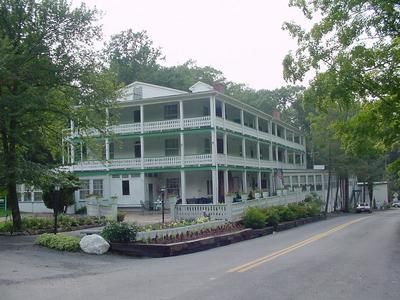
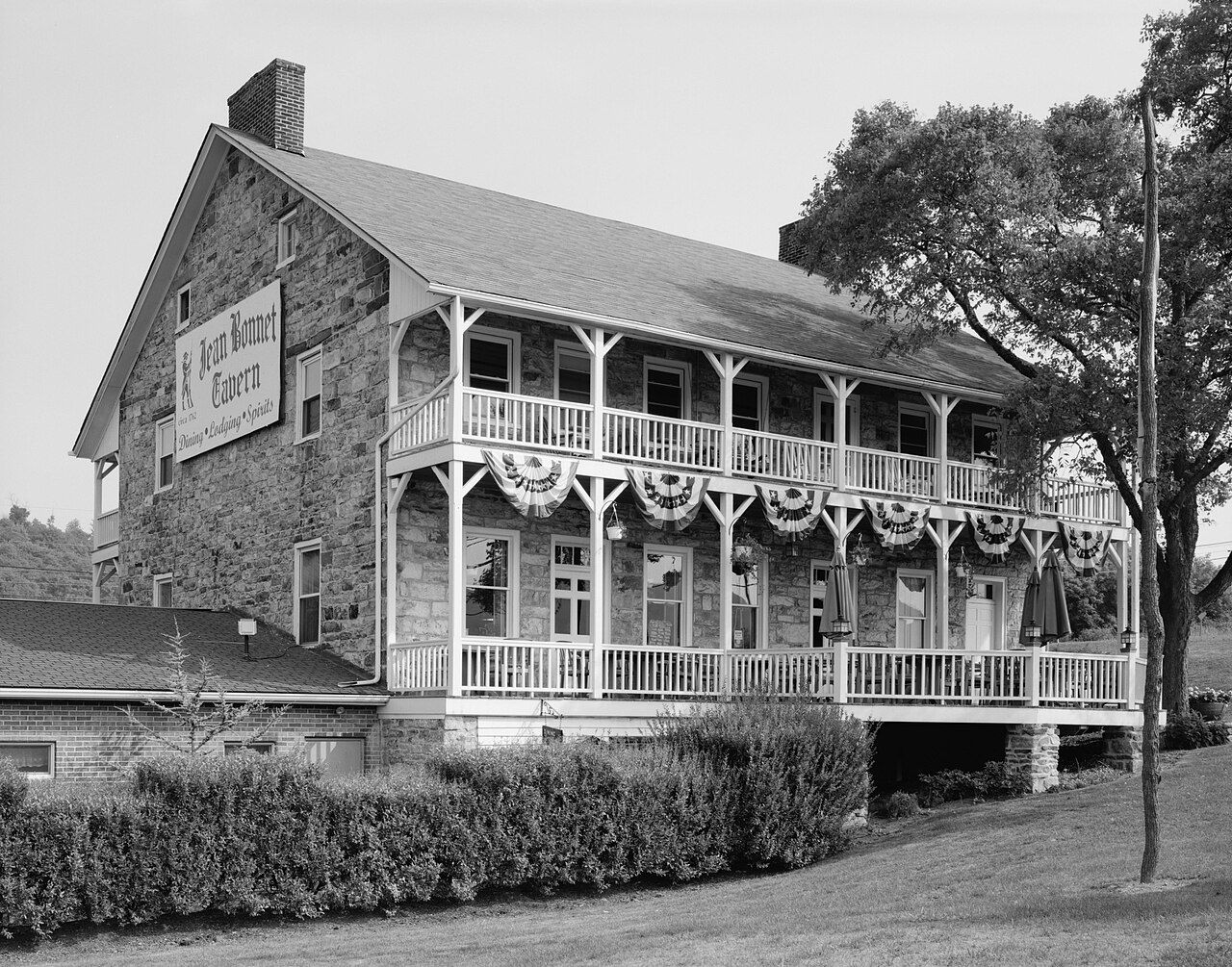
A banked fieldstone tavern with double galleries at the fork of the Forbes and Burd roads west of Bedford, licensed as a public house by Jean Bonnet in 1779 and a rallying point in the Whiskey Rebellion.
History
Two Indian paths, the Raystown and the Glade, met near this spot four miles west of Bedford. British troops widened the Glade Path into Burd's Road in 1755, and in 1758 General John Forbes cut his military road along the Raystown Path toward Fort Duquesne; once settlement was allowed west of the Allegheny Front, settlers, drovers and pack trains crowded both. The land was part of 690 acres sold by the Penn proprietors to the speculator Hans Ireland in 1762 and passed through the Indian trader Robert Callender in 1772–73. The stone building probably went up somewhere between 1762 and 1779, though no record fixes the year.
In 1779 Jean (John) Bonnet bought the property and petitioned to keep a public house, which he ran until his death in 1793. His daughter Elizabeth inherited the tavern, and her husband John Ewalt was keeping it in 1794 when farmers protesting the federal whiskey excise rallied here and raised a liberty pole, months before federal troops marched west to end the Whiskey Rebellion. Simon Stuckey bought it in 1815, and his family kept it through the busy turnpike era of the Bedford and Stoystown and Glade Pikes until at least 1842, as canals and then railroads drew off long-distance traffic. After George Stuckey's debts forced a sale in 1874, the building served as a farmhouse, notably for the Souser family, until Frank and Lucille Enyeart bought it in 1957 and reopened it as the Old Forks Inn. Ghost stories attached to Bonnet date from their era.
“Tied closely to the development and expansion of Bedford County is the history of the Old Forks Inn.”
Architecture
The tavern measures 40 by 51 feet and is built of cut fieldstone laid as random ashlar, with walls more than two feet thick. Set into a bank, it is two and a half stories on one side and three and a half on the other, giving four levels and close to 8,000 square feet. Two tiers of galleries run the full length of both the south and north fronts, reached only from inside; the county planning staff who studied it in 1979 knew of no other local tavern with galleries on opposite walls. Its roof is shallower and its plan squarer than most Bedford County buildings of the period. Brick end chimneys and stone interior stacks serve eight large fireplaces, and hewn chestnut beams are exposed in the basement taproom and first floor.
What to look for
- Two-story galleries on both the north and south walls
- Random-ashlar fieldstone walls over two feet thick
- The road fork that gave the Old Forks Inn its name
- Exposed hewn chestnut beams in the basement taproom
- John Sill's smaller stone tavern just to the east
Setting
The tavern stands at the junction of U.S. Route 30 (the Lincoln Highway, here following Forbes Road) and Pennsylvania Route 31 (the Glade Pike, following Burd's Road), about four miles west of Bedford and in sight of the Pennsylvania Turnpike. The Raystown Branch of the Juniata runs about half a mile east, near the village of Napier, once called Stuckeyville. John Sill's stone tavern stands a few hundred yards east.
Timeline
- 1758Forbes Road cut past the site
- 1762Hans Ireland buys the 690-acre tract
- 1779Jean Bonnet buys the property and opens a public house
- 1794Whiskey Rebellion insurgents rally at the tavern
- 1815Simon Stuckey buys the tavern
- 1874Sold for debts; used as a farmhouse
- 1957Enyearts reopen it as the Old Forks Inn
Where sources differ
- The construction date is uncertain. The nomination form gives both c. 1762 and c. 1769 and credits Bonnet as builder, while the 1979 deed research filed with it shows Bonnet did not buy the land until 1779. Wikipedia credits Robert Callender and gives 1762 or 1763.
- Claims of an Indian village or a French fort on the site were rejected by the county researchers whose findings are filed with the nomination.
- Wikipedia places the Whiskey Rebellion gathering under Bonnet; the deed research shows Bonnet had died in 1793 and his son-in-law John Ewalt kept the tavern in 1794.
- The ghost of Bonnet is a modern legend.