Inn · Lambertville, New Jersey · Built 1812; Italianate enlargement c. 1865–1875
Lambertville House
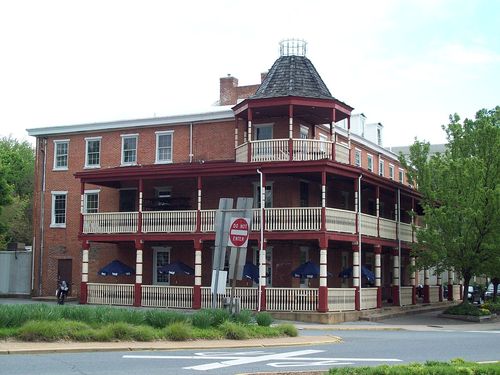
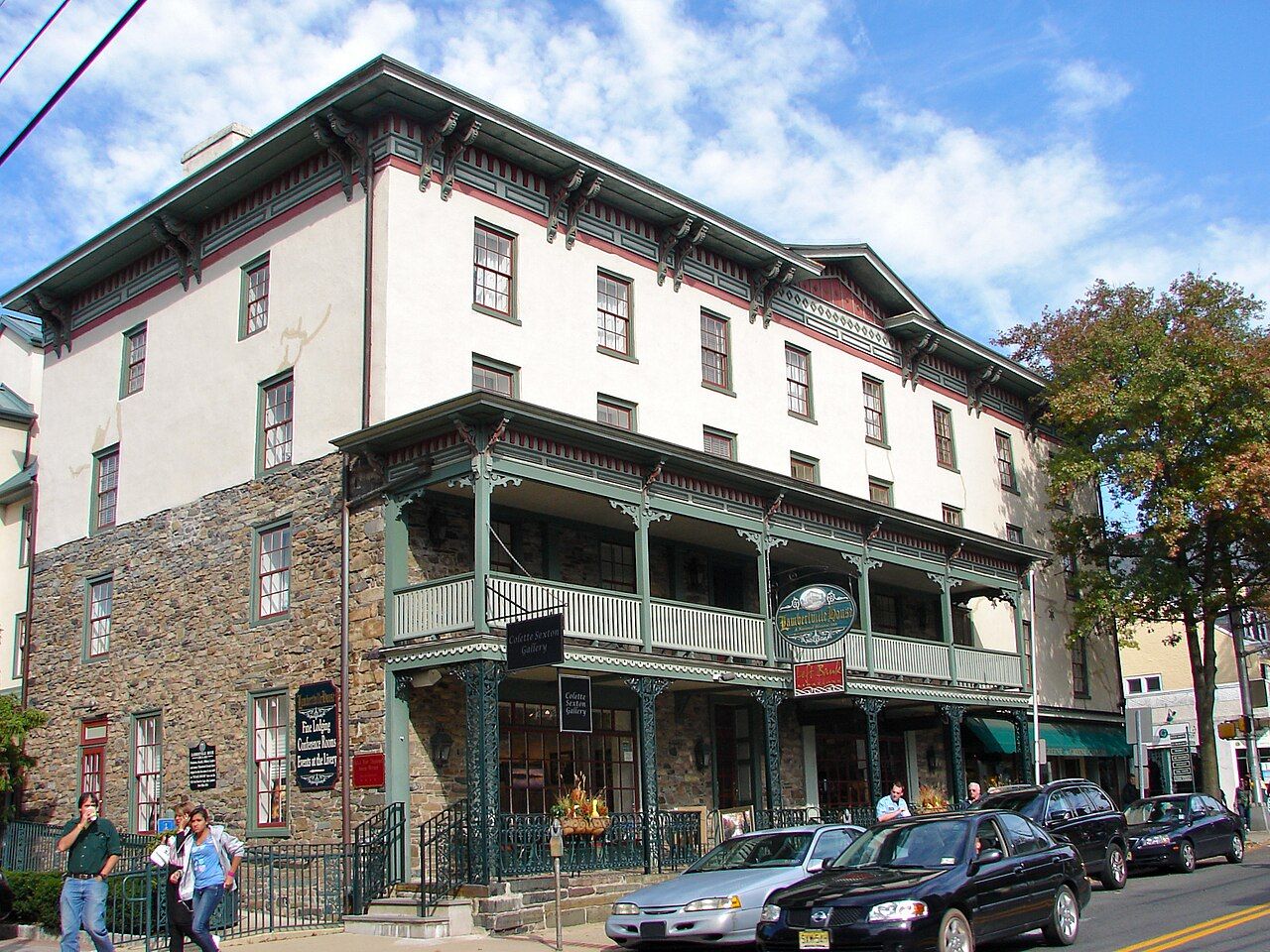
A fieldstone tavern built in 1812 by Captain John Lambert at the New Jersey end of the new Delaware River bridge, later wrapped in a four-story Italianate hotel with a two-tier iron-and-wood veranda.
History
In 1812 a covered wooden bridge was thrown across the Delaware between the small settlement then called Coryell's Ferry and New Hope, Pennsylvania. The road to it, until then a minor one, became a through route between New York and Philadelphia, and Captain John Lambert put up a three-and-a-half-story fieldstone tavern facing it the same year. The bet paid off. Lambert's uncle, also named John Lambert, a former governor of New Jersey then sitting in the U.S. Senate, arranged for a post office to open in 1814 with the captain as postmaster and the tavern as the office. The post office was named Lambert's Ville, and the town took the name. County tavern licenses show the younger Lambert keeping the house from 1814 until about 1826.
After Lambert's death the tavern changed hands many times but, according to the nomination, never stopped being an inn. Sometime in the third quarter of the century, probably after the Civil War, an owner engulfed the old stone house in a much larger brick Italianate hotel, at least doubling its size. Its register is said to have included President Andrew Johnson, General Ulysses S. Grant, Senator Thaddeus Stevens, Robert Todd Lincoln and Edward, Prince of Wales, along with touring opera companies, Swiss bell ringers and the silent-film star Pearl White. By the 1970s the ground floor held shops as well as the inn. The building was listed in 1978 and became part of the Lambertville Historic District in 1983.
“Previously the road had been a secondary one, but construction of the covered wooden span across the Delaware re-oriented the focus of the town establishing Bridge Street as a major thoroughfare between New York and Philadelphia.”
Architecture
The 1812 core is a center-hall fieldstone building with paired gable-end chimneys, built over hewn oak beams on an eighteen-inch fieldstone foundation. Inside, two Adamesque mantels, corner fireplaces in the west rooms and Greek-shouldered door and window casings survive. The later addition raised the Bridge Street front to four stories and eight bays, extending five bays down Union Street, under a low roof with a central cross gable, paired eave brackets and a decorated frieze. A false front hides the old gable roof on the west end. The street front is masked by a two-tier flat-roofed veranda, with cast-iron posts and brackets below and sawn wooden brackets above.
What to look for
- Two-tier veranda with iron posts below and wooden brackets above
- Paired brackets and central cross gable on the four-story front
- False front on the west gable end
- The Delaware River bridge to New Hope at the foot of Bridge Street
Setting
The hotel stands at the corner of Bridge and Union Streets in the center of Lambertville, a short walk from the bridge across the Delaware River to New Hope, Pennsylvania. The surrounding blocks of nineteenth-century houses, shops and churches make up the Lambertville Historic District, and the Delaware and Raritan Canal feeder runs between the town and the river.
Timeline
- 1812Capt. John Lambert builds the stone tavern; Delaware bridge opens
- 1814Post office of Lambert's Ville opens in the tavern
- c. 1826Lambert dies; tavern passes through many owners
- c. 1865–1875Four-story Italianate hotel built around the old tavern
- 1978Listed on the National Register
- 1983Included in the Lambertville Historic District
Where sources differ
- Lambert's death is given as about 1826 in the nomination and 1828 by Wikipedia.
- The date of the Italianate enlargement is estimated, not documented.
- The list of famous guests comes from local tradition and secondary histories.