Tavern · Alexandria, Virginia · Built c. 1785; City Tavern and Hotel 1792
Gadsby's Tavern
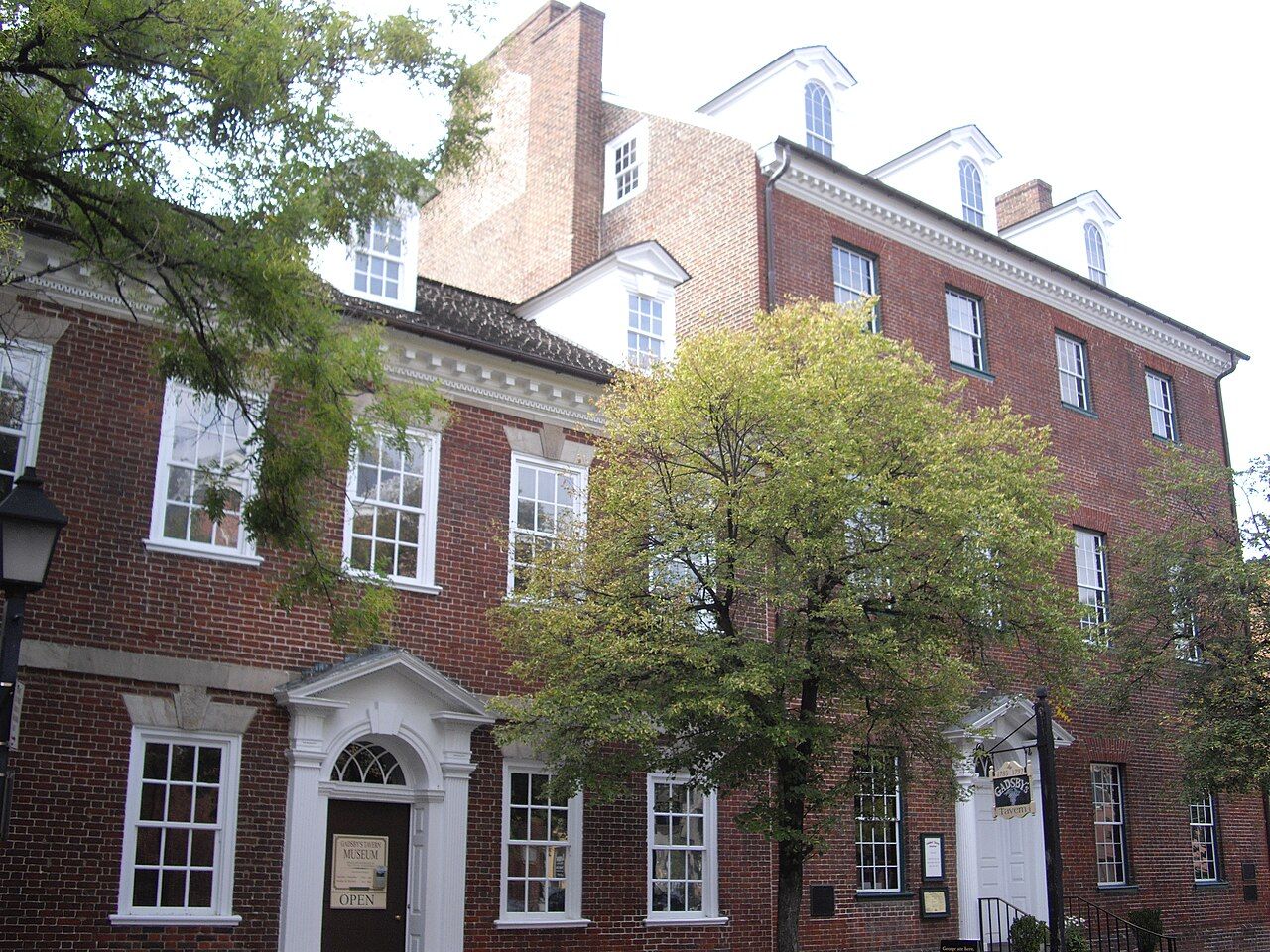
Two brick taverns at Royal and Cameron Streets in Old Town Alexandria, a Georgian tavern of about 1785 and John Wise's three-story City Hotel of 1792, made famous by John Gadsby and frequented by George Washington.
History
Taverns stood on this corner of Royal and Cameron Streets from the town's early years. After the Revolution, the Maryland-born John Wise bought the corner lot in 1782 and built the smaller, Georgian-style tavern about 1785, then a much larger three-story brick City Tavern and Hotel beside it, which opened in February 1792 with festivities for Washington's birthday. The Englishman John Gadsby leased the new building in the mid-1790s and from 1802 ran both together until he left for Baltimore in 1808. Under him the place became known up and down the coast; the nomination says he ran his own stage line to Philadelphia, with tickets reserved for his guests.
Washington was a regular. He attended the annual birthnight ball in the ballroom, and in November 1798, after a dinner the nomination describes as canvasback duck, hominy and Madeira, he reviewed the Alexandria Independent Blues from the doorway in his last military appearance. Thomas Jefferson was honored with a banquet in 1801, and Lafayette was fêted during his 1824 tour. After Wise's death in 1815 the buildings served as a hotel, offices and auction rooms, and Alexandria's legend of the Female Stranger, a young woman who died in the hotel in 1816 and was buried anonymously in St. Paul's churchyard, began here. By 1900 the hotel had closed and decayed into shops and flats. In 1917 the Metropolitan Museum of Art bought the ballroom woodwork, which it installed in its American Wing. American Legion Post 24 bought the buildings in the 1920s to save them, and the city reopened them in 1976 as a museum and restaurant.
“From Boston to New Orleans, the better-off traveler did his best to make Gadsby's.”
Architecture
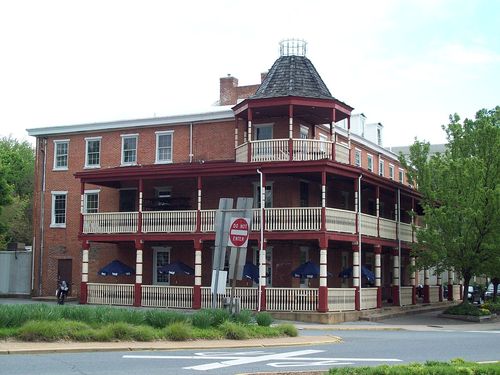
The corner tavern is a brick Georgian building with a modillioned cornice trimmed with fretwork, three dormers and flat arches with large stone keystones over the windows. Its doorway has fluted pilasters and a broken pediment rising over a round-arched, keystoned transom. The 1792 hotel is a larger, plainer three-story brick building. Its second-floor ballroom, with fine carved paneling and a musicians' gallery projecting over the floor, is now reproduced in place; the original woodwork is in New York. The main doorway, sold to the Metropolitan in the 1920s, was bought back in 1949. Behind are a cobbled courtyard and an underground brick icewell and kitchen area excavated before the 1976 restoration.
What to look for
- Broken-pediment doorway with fluted pilasters on the corner tavern
- Large keystones over the windows
- Reproduced 1792 ballroom with its musicians' gallery
- Cobbled rear courtyard
Setting
The taverns stand at 134 and 138 North Royal Street at the corner of Cameron Street in Old Town Alexandria, across Royal Street from City Hall and Market Square. The grid of eighteenth- and nineteenth-century brick houses and shops around them makes up the Alexandria Historic District, and the Potomac waterfront is a few blocks east. St. Paul's Cemetery, with the Female Stranger's table tomb, is on the south side of town.
Timeline
- 1782John Wise buys the corner lot
- c. 1785Smaller Georgian tavern built
- 1792City Tavern and Hotel opens in February
- 1796John Gadsby leases the City Tavern
- 1798Washington's last military review at the tavern
- 1917Metropolitan Museum buys the ballroom woodwork
- 1976Reopened by the city as a museum and restaurant
Where sources differ
- The landmark nomination dates the smaller tavern to 1752 and links it to Washington's 1754 recruiting and the Fairfax Resolves; later research summarized by Wikipedia dates the building to about 1785, so those earlier events likely belong to a predecessor tavern on or near the site.
- Gadsby's lease is dated 1794 in the nomination and 1796 by Wikipedia.
- The Female Stranger and her ghost are local legend.