Resort hotel · White Sulphur Springs, West Virginia · Built Cottages c. 1800–1860; main hotel 1913; wings 1930–31
The Greenbrier
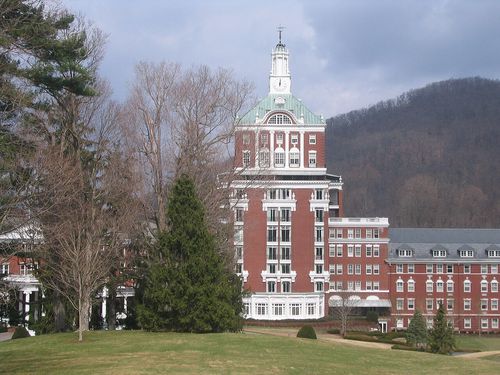
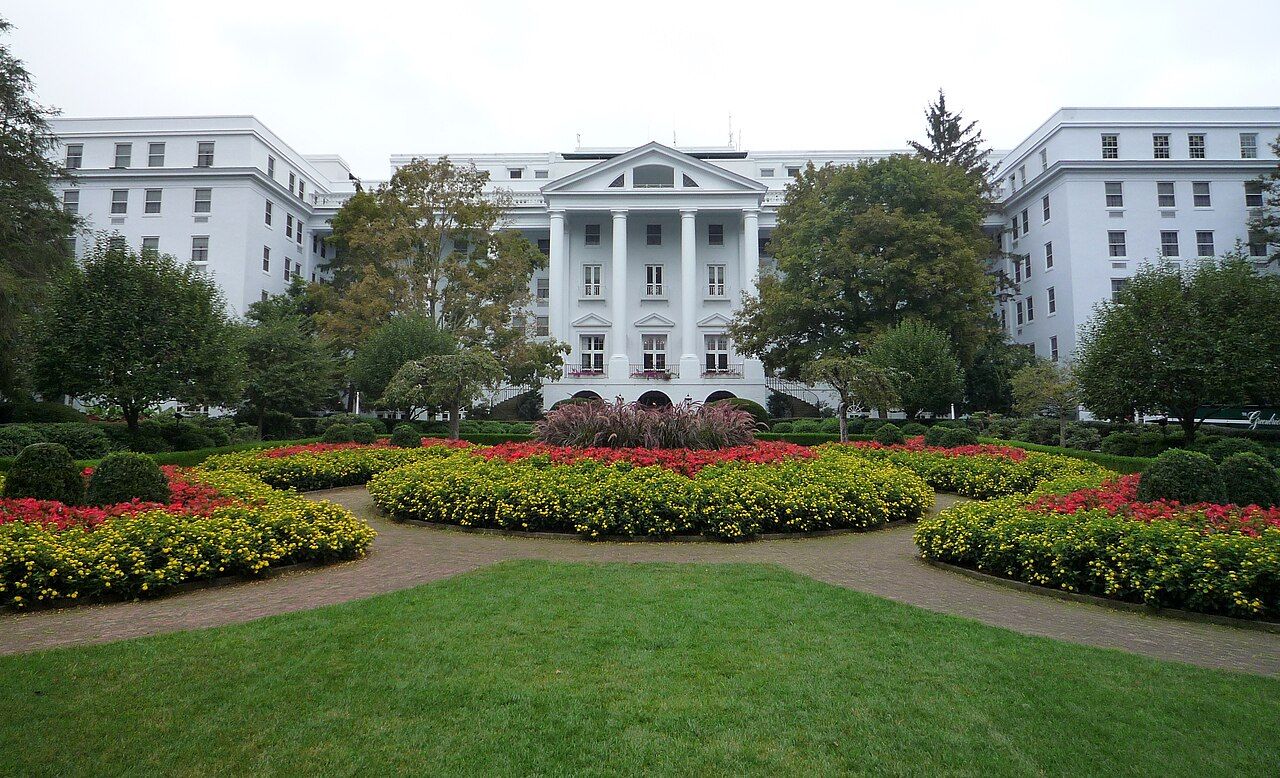
The old "Queen of Southern Spas" at White Sulphur Springs: antebellum cottage rows around a domed spring house, and a white Georgian Revival hotel the Chesapeake & Ohio Railway built in 1913 and enlarged in 1930–31.
History
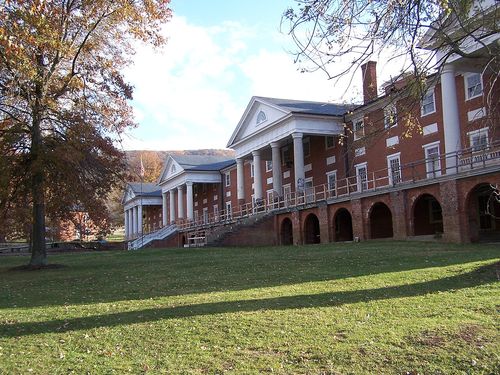
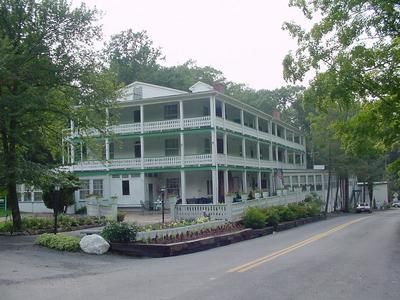
Settlers knew the sulphur spring on Howard's Creek by the 1770s, and tradition credits a Mrs. Anderson with curing her rheumatism in its water in 1778. Michael Bowyer, heir to the original claim, began letting visitors stay; attached cottages of Paradise Row went up around 1800, and in 1809 Bowyer and his son-in-law James Calwell built a tavern. The James River and Kanawha Turnpike, open by 1824, put the springs on the main road west, and wealthy planters made the summer journey here to escape lowland heat and display themselves to their peers. The New Orleans planter Stephen Henderson built the colonnaded cottage of 1816 later used by Presidents Van Buren, Tyler and Fillmore. In the 1830s John H.B. Latrobe, son of the architect Benjamin Latrobe, helped design the porched Baltimore Row, and Calwell added further rows.
Virginia investors who bought the resort in 1857 opened the 400-foot Grand Central Hotel, the "Old White," in June 1858, where secessionists such as Edmund Ruffin courted Southern visitors. Both armies used it during the Civil War. Robert E. Lee summered here from 1867, staying in a Baltimore Row cottage. The Chesapeake & Ohio Railway bought the property in 1910, added a bath wing and an 18-hole golf course, and opened Sterner's new hotel, named the Greenbrier, in 1913; the Old White came down in 1922. During World War II the hotel held interned Axis diplomats and then served as the Army's Ashford General Hospital. Dorothy Draper redecorated it for a celebrated 1948 reopening, and from 1959 to 1962 a secret bunker for Congress was built beneath the new West Virginia Wing. It was revealed in 1992.
“Known from its beginning as the "Queen of Southern Spas," this West Virginia watering place has always been fashionable”
Architecture
Sterner's 1913 hotel is a seven-story, white-painted block of brick and stucco on a steel and concrete frame, with a colonnade running the length of the front and a projecting entrance: broad two-story piers carry an arch, and above it four-story columns rise to a tall pediment centered on a geometric oval. Later wings of 1930–31, 1954 and 1962 follow its lines. Around the lawn stand the earlier buildings: the domed spring house of the 1830s on twelve columns, once topped by a statue of Hygeia and later Hebe; the two-story Federal brick Presidents' Cottage of 1816 with double colonnaded porches; and the cottage rows, whose hipped roofs extend over columned porches in the style known locally as Old White cottages.
What to look for
- Green-domed spring house over the sulphur spring
- Two-story columned entrance and pediment of the 1913 hotel
- Presidents' Cottage with double porches
- Baltimore Row cottages, including Lee Cottage
- Paradise Row, the earliest guest cottages
Setting
The resort lies off U.S. Route 60 at the west end of White Sulphur Springs, in the valley of Howard's Creek ringed by the Allegheny Mountains. The cottage rows curve in a semicircle around the springs and the main lawn, facing the hotel, with formal gardens nearby and golf courses spreading across the valley floor. The Amtrak station built for hotel guests in 1931 stands across the highway.
Timeline
- 1778Mrs. Anderson's cure popularizes the spring
- c. 1800Paradise Row cottages built
- 1816Stephen Henderson builds the Presidents' Cottage
- 1858Grand Central Hotel, the Old White, opens
- 1913Chesapeake & Ohio opens the Greenbrier hotel
- 1942–1946Used as Ashford General Hospital
- 1959–1962Congressional bunker built under the West Virginia Wing
Where sources differ
- The nomination dates Paradise Row both to about 1800 and to the 1820s, and the North and Virginia wings to 1930 and 1931.
- Mrs. Anderson's 1778 cure is a tradition; the nomination also spells the architect's middle name Junius where Wikipedia has Julius.