Resort hotel · Hot Springs, Virginia · Built 1902–1914; tower 1929 (bathhouse and cottages 1892)
The Homestead
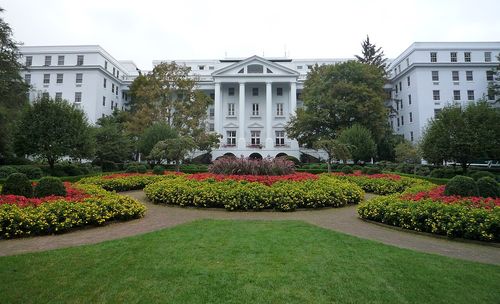
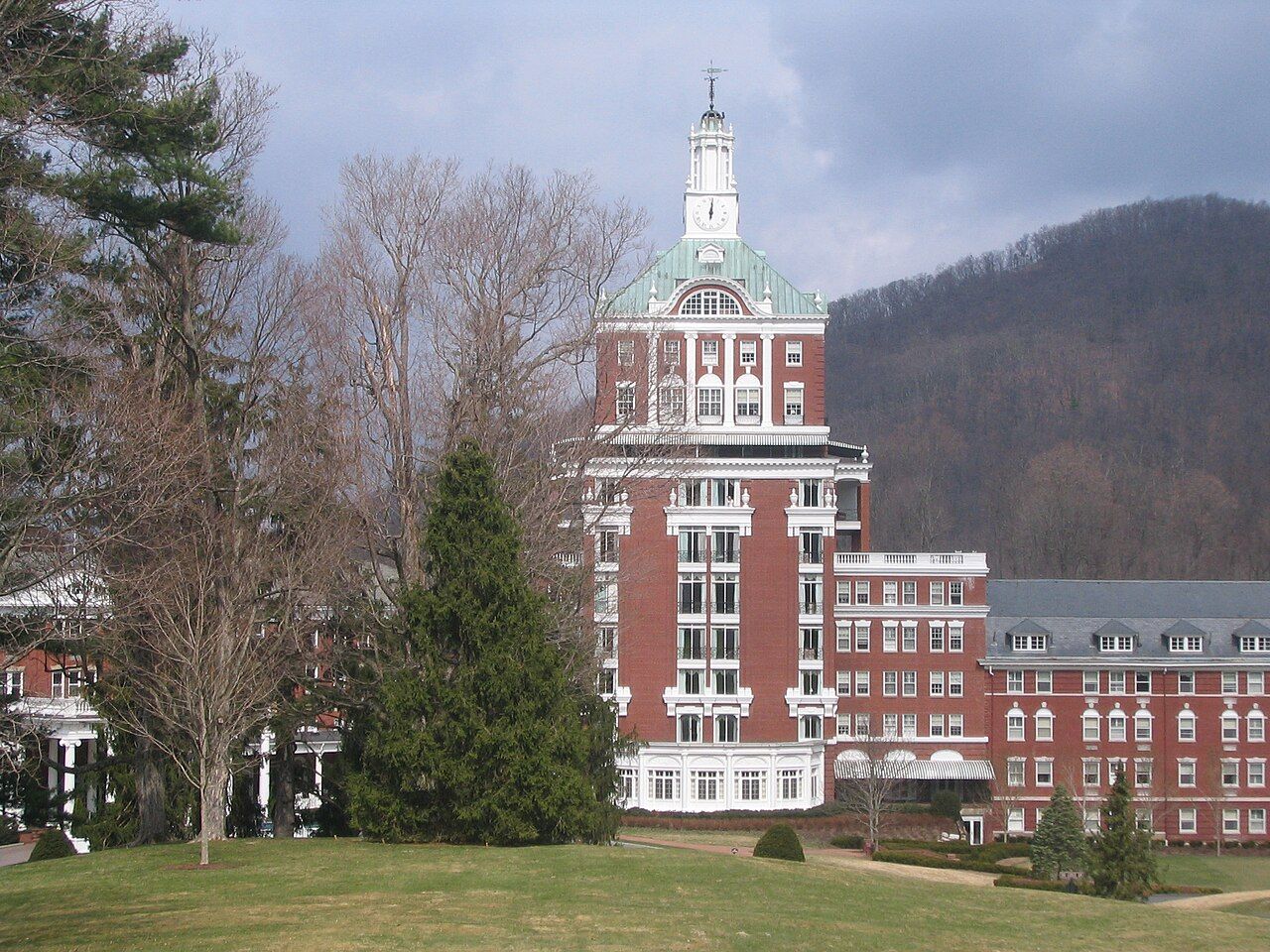
A red-brick Georgian Revival spa hotel in Virginia's Warm Springs Valley, rebuilt after a 1901 fire on a resort site dating to the 1760s and crowned by Warren & Wetmore's ten-story clock tower of 1929.
History
The explorer Dr. Thomas Walker passed the springs in 1750 and found six invalids bathing in water he judged warmer than new milk. Thomas Lewis and Thomas Bullitt patented the Hot Springs tract in 1755 on a promise to build a hotel, and a house called the Homestead stood there before 1766, though travelers complained of its rough lodging and thin fare. For decades Hot Springs trailed nearby Warm Springs, until Dr. Thomas Goode bought the resort in 1832, advertised its waters for everything from gout to spinal ailments, built new bathhouses and in 1846 opened a new frame Homestead about 200 feet long. After his death in 1858 and through the Civil War, business dwindled.
In 1891 a syndicate tied to the Chesapeake & Ohio Railroad bought the property, formed the Virginia Hot Springs Company and ran a branch line in from Covington. Under M.E. Ingalls and manager Fred Sterry, later of New York's Plaza, it became a fashionable year-round resort, with an elaborate bathhouse of 1892. On July 2, 1901, fire leveled the 200-room hotel in three hours. Ingalls wired his architects the next morning, and the main section reopened in spring 1902, with wings following through 1914 and a dining room, ballroom and theater in 1921. The million-dollar tower opened in 1929. William Howard Taft spent the summer of 1908 here. From December 1941 to June 1942 the government interned Japanese diplomats at the hotel, and in 1943 it hosted the conference that led to the UN Food and Agriculture Organization. It was designated a National Historic Landmark in 1991.
“The hotel's most impressive architectural feature is its ten-story tower.”
Architecture
Elzner & Anderson's 1902 main block is a three-story red-brick Georgian Revival front of fourteen bays, with a central pedimented pavilion, brick pilasters and a two-story Ionic portico flanked by Doric verandas. Inside, the Great Hall runs 200 feet between two rows of sixteen two-story Corinthian columns under a coffered ceiling. Long brick wings with gambrel roofs, rusticated stories and columned porticoes reach back from it. Between the main block and the east wing rises Warren & Wetmore's tower: seven stories of corner sleeping porches below a refined upper stage with quoins, Ionic pilasters and scroll pediments, topped by a round clock cupola ringed with Corinthian columns, modeled on the Temple of Vesta. The 1892 bathhouse, Casino pavilion and a row of eleven frame cottages survived the fire.
What to look for
- Clock cupola ringed by Corinthian columns atop the 1929 tower
- Double-row Ionic portico on the main front
- The 200-foot columned Great Hall
- Spring houses and gazebos on the north lawn
- Row of 1890s cottages along the stream west of the hotel
Setting
The hotel sits on a gentle rise above Hot Springs in the narrow Warm Springs Valley of Bath County, with the Allegheny ridges on both sides. Lawns around it hold the thermal springs, several sheltered by small gazebos, and the octagon-turreted Casino. U.S. Route 220 runs past, the Cascades golf course lies south, and the domed 18th-century bathhouses of Warm Springs are five miles north.
Timeline
- 1755Hot Springs tract granted to Thomas Lewis and Thomas Bullitt
- c. 1766First Homestead hotel built
- 1846Dr. Thomas Goode opens a new Homestead
- 1891Railroad-linked syndicate buys the resort
- 1901Fire destroys the hotel on July 2
- 1902Rebuilt main section reopens
- 1929Warren & Wetmore tower completed
Where sources differ
- Wikipedia credits Thomas Bullitt alone with a 1766 lodge and names J.P. Morgan as head of the investors of 1888–92; the nomination describes a 1755 grant to Lewis and Bullitt, a hotel built before 1766, and an 1891 purchase by a Chesapeake & Ohio syndicate.
- Counts of presidents who stayed at the hotel are promotional and unverified.