Resort hotel · Sweet Springs, West Virginia · Built c. 1830–1833 (main hotel); cottages 1850s
Old Sweet Springs
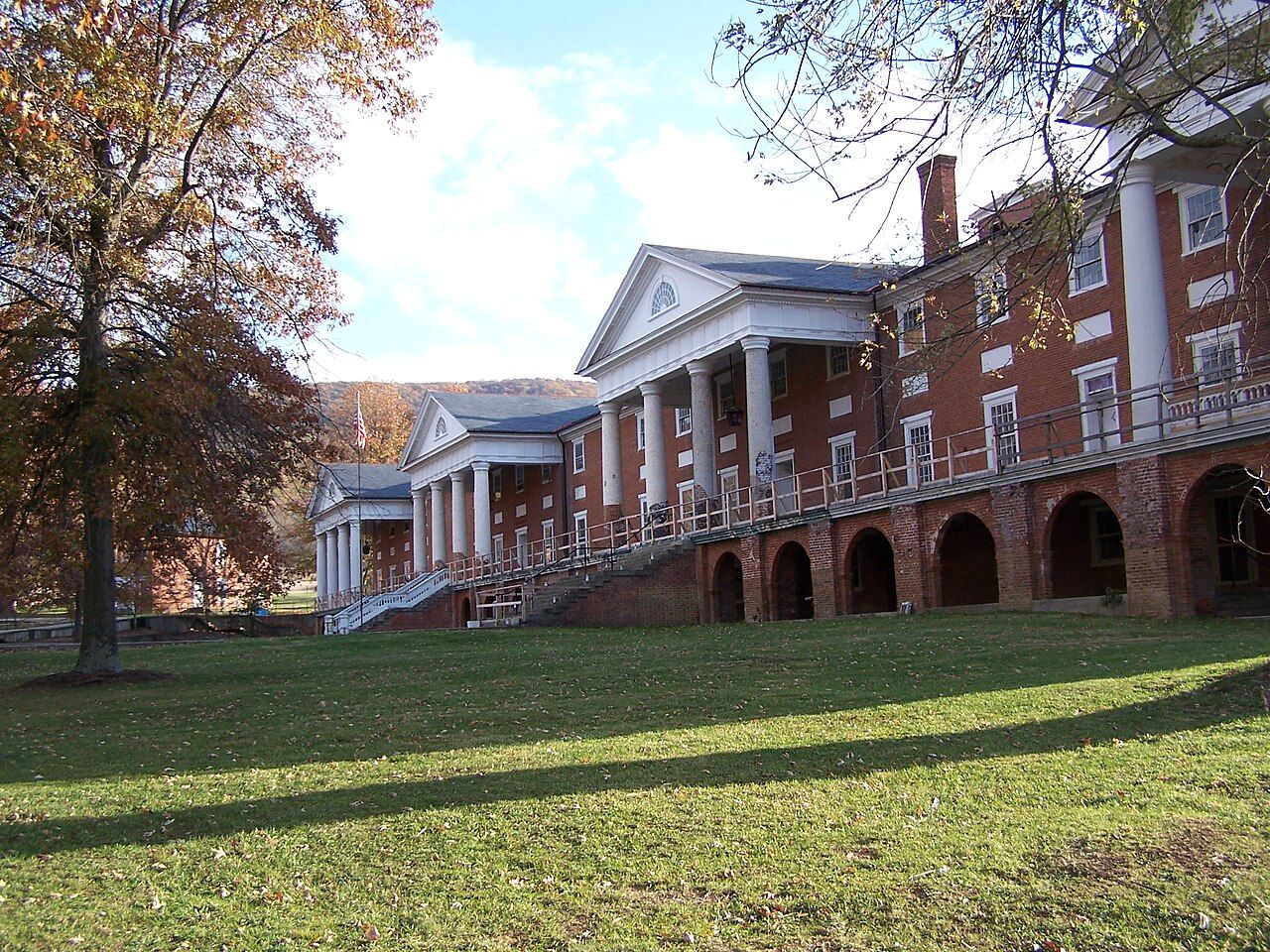
One of Virginia's old mineral-spring resorts: a long brick hotel of the early 1830s in the manner of Jefferson's Charlottesville buildings, with a quarter-circle of 1850s brick guest houses, later a state home for the aged.
History
William Lewis, a Revolutionary veteran and brother of General Andrew Lewis, held the Sweet Springs tract under a 1774 patent; a squatter, James Moss, had built a cabin there around 1760 and was turned off. Lewis moved to the springs in 1783 and promoted them as a resort, and by the 1790s about fifty guests at a time were lodged in log cabins. He planned a town with shops kept out of the residential streets; it never grew, though a circuit court serving four counties sat here from 1795 to 1817, and Lewis was criticized for putting guests in the courthouse and jail when they stood empty. A 1802 lawsuit over leased land in the county pitted Thomas Jefferson against Aaron Burr.
The present main building replaced the early structures in the early 1830s. Its design, in the classical manner of the University of Virginia, has often been credited to Jefferson, but he died in 1826 and the nomination suggests it was built by someone in his circle. In 1852 John Echols, Allen T. Caperton and Oliver Beirne formed a company and began a grand semicircular plan of brick cottages, about half of which was built. Without a railroad, Sweet Springs lost ground to White Sulphur and Hot Springs. A 1929 film, Glorious Betsy, shot here inspired investors to buy the resort, but it went into receivership in 1930. West Virginia bought it in the early 1940s and ran it as the Andrew S. Rowan Memorial Home for the aged, named for the officer who carried the "message to Garcia" in 1898, until 1991. Later private owners began restoring it.
“The tradition of a Jerome Bonaparte courtship and marriage there seems to have stemmed entirely from the filming of a movie version of "Glorious Betsy" at Sweet Springs.”
Architecture
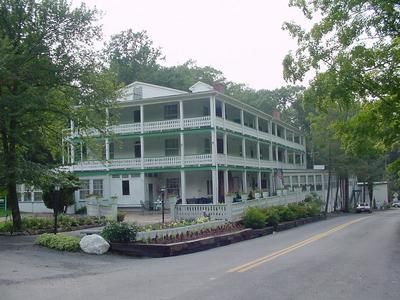
The main hotel, called the Jefferson Building, is a long two-story building of handmade brick with a classical portico and arcaded ground floor, in the Roman Revival manner Jefferson's workmen spread across Piedmont Virginia; the restoration architects of Colonial Williamsburg later cited it as a model for the Williamsburg Inn. Facing it across the lawn is the quarter-circle of two-story brick guest houses from the 1850s plan, along with the Ball Building and the older Elbow Row cottage. A church-like bath house replaced an earlier wooden one over the spring. The state's conversion in the 1940s altered interiors and added a rear wing but kept the exteriors.
What to look for
- Jeffersonian portico of the main hotel
- Quarter-circle of 1850s brick guest houses
- Church-like bath house over the spring
- Handmade brick of the antebellum buildings
Setting
Sweet Springs lies in the Sweet Springs Valley of eastern Monroe County, close to the Virginia line, on West Virginia Route 3 between Gap Mills and the Virginia border. The buildings stand around a broad lawn at the foot of Peters Mountain, with farmland stretching down the valley. The warm mineral spring that gave the place its name rises within the grounds.
Timeline
- 1774Lewis family patents the Sweet Springs tract
- 1783William Lewis moves to the springs and develops the resort
- 1795–1817Circuit court sits at Sweet Springs
- c. 1830–1833Present main hotel built
- 1852Echols, Caperton and Beirne begin the cottage plan
- 1930Resort goes into receivership
- 1941–1991State ownership; Andrew S. Rowan Memorial Home
Where sources differ
- Attribution of the main building to Thomas Jefferson is doubted by the nomination, which notes he died before it was built.
- Visits by Washington, Madison and Lafayette listed by Wikipedia are not supported in the nomination, which says evidence of early famous guests is scanty; Pierce and Fillmore appear in the register.
- The state purchase is dated 1941 in the nomination and 1945 by Wikipedia; the planned town is spelled Fortville in the nomination and Fontville by Wikipedia.
- The portico and arcade description draws on the building's well-known appearance; the 1970 nomination itself gives little architectural detail.