Inn · Lebanon, Ohio · Built 1815; third story c. 1846; north wing c. 1854; fourth story 1878
The Golden Lamb
Listed on the National Register as Golden Lamb Inn
A brick tavern on Lebanon's Broadway, licensed as a log public house in 1803 and rebuilt in brick by Ichabod Corwin in 1815, raised to four stories by 1878, and a stage stop between Cincinnati and Columbus.
History
On December 23, 1803, the Warren County court licensed Jonas Seaman of New Jersey to keep a house of public entertainment in a log building on the main street of the new county seat. Debts forced Seaman out, and in 1815 Ichabod Corwin, one of Lebanon's founders, replaced the log tavern with a two-story brick inn. Benjamin Rue, a Revolutionary veteran who had built the Crossed Keys Tavern near Fort Ancient, managed it from 1818, and it quickly became the meeting place of the town's lawyers and politicians. With no theater in town, it also staged traveling shows, animal acts and plays. An 1827 newspaper notice is the earliest record of the name: the Ohio and Pennsylvania Hotel at the Sign of the Golden Lamb.
Henry and Mary Share kept the inn from 1820, adding a rear wing in 1826; Calvin Bradley ran it as the Bradley House around 1840, when Charles Dickens stopped here and recorded the visit in American Notes. Isaac Stubbs and his heirs owned it from 1843 to 1914, when it was usually called the Lebanon House. Coaches between Sandusky, Columbus and Cincinnati stopped at the door, Henry Clay passed through on journeys between Kentucky and Washington, and DeWitt Clinton was honored at a dinner here in 1825. In 1871 the Copperhead politician Clement Vallandigham accidentally shot himself in his room while demonstrating his defense in a murder case. Robert Jones leased the inn in 1926 and filled it with Shaker furniture from nearby Union Village.
“The Golden Lamb was immediately popular, particularly as a meeting area for men of law and politics.”
Architecture
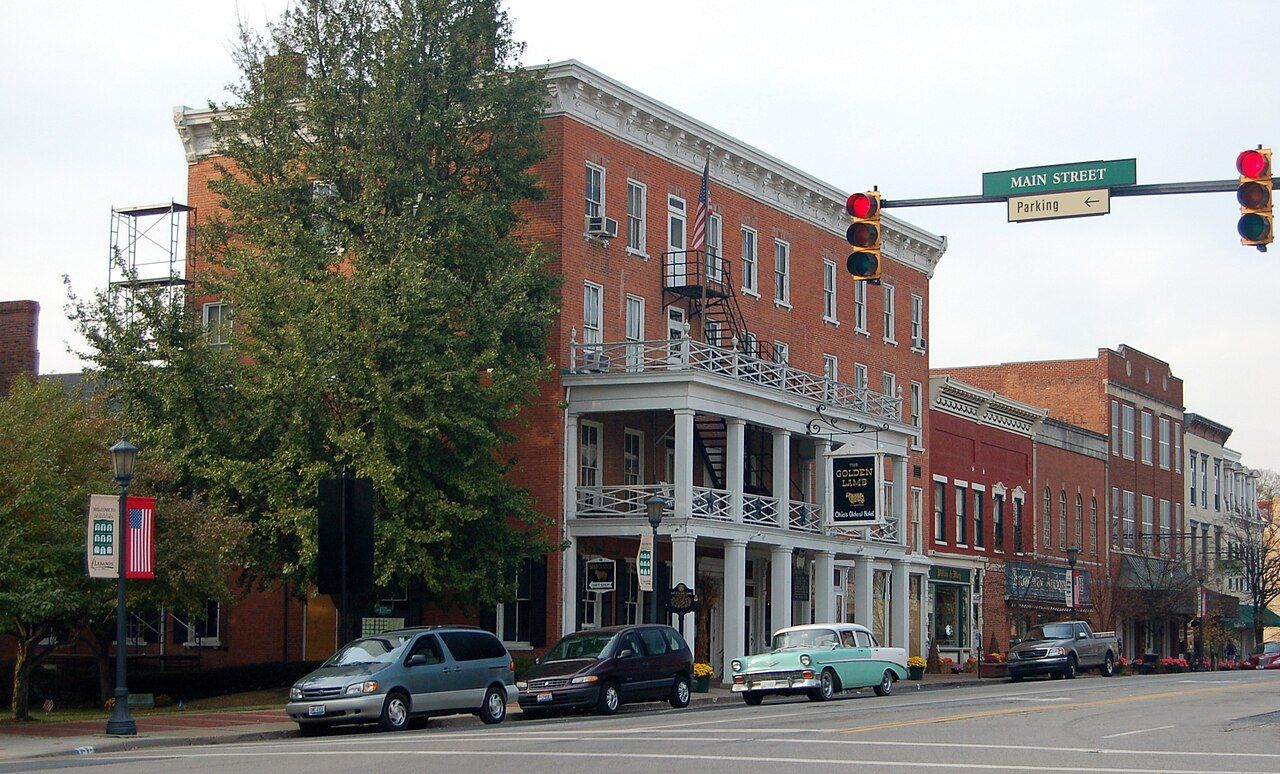
The Golden Lamb is a four-story, L-shaped brick building ten bays long on South Broadway, with a two-story 1826 wing behind and a one-story addition of 1964. The ground floor of the six southernmost bays is Corwin's 1815 tavern, and its original pilastered doorway with fanlight and deep cornice survives, though the door is new. A third story was added about 1846, a four-bay north wing about 1854, and the fourth story in 1878 to house men building the railroad. For years the brick was painted white, with iron balconies as fire escapes; in the 1930s it was sandblasted and the present three-tier columned porch added across the old section, under a bracketed and paneled cornice. Two upper rooms display Shaker furniture.
What to look for
- Pilastered 1815 doorway with fanlight
- Golden lamb sign hung from the porch
- Three-tier porch across the oldest section
- Seams of the c. 1846 and 1878 upper stories in the brickwork
- Shaker rooms on the fourth floor
Setting
The inn stands at 27–31 South Broadway at the corner of Main Street in the center of Lebanon, the Warren County seat, between Cincinnati and Dayton. Its hanging lamb sign marks the old main street, lined with nineteenth-century brick storefronts, and the Warren County Historical Society's museum, with its Shaker collection, is a short walk away.
Timeline
- 1803Jonas Seaman licensed to keep a log tavern
- 1815Ichabod Corwin builds the brick inn
- 1825Dinner for DeWitt Clinton
- 1827First recorded use of the Golden Lamb sign
- 1842Charles Dickens stops at the Bradley House
- 1871Clement Vallandigham's fatal accident
- 1878Fourth story added
Where sources differ
- The nomination dates Dickens's visit to Calvin Bradley's tenure; Dickens's American tour was in 1842.
- Lists of presidents who visited the inn come from local tradition; guest rooms are named for many of them.
- The story that the lamb sign was chosen for illiterate travelers is traditional.