Inn · Burnsville, North Carolina · Built c. 1833; enlarged c. 1870 and 1915–1917
Nu-Wray Inn
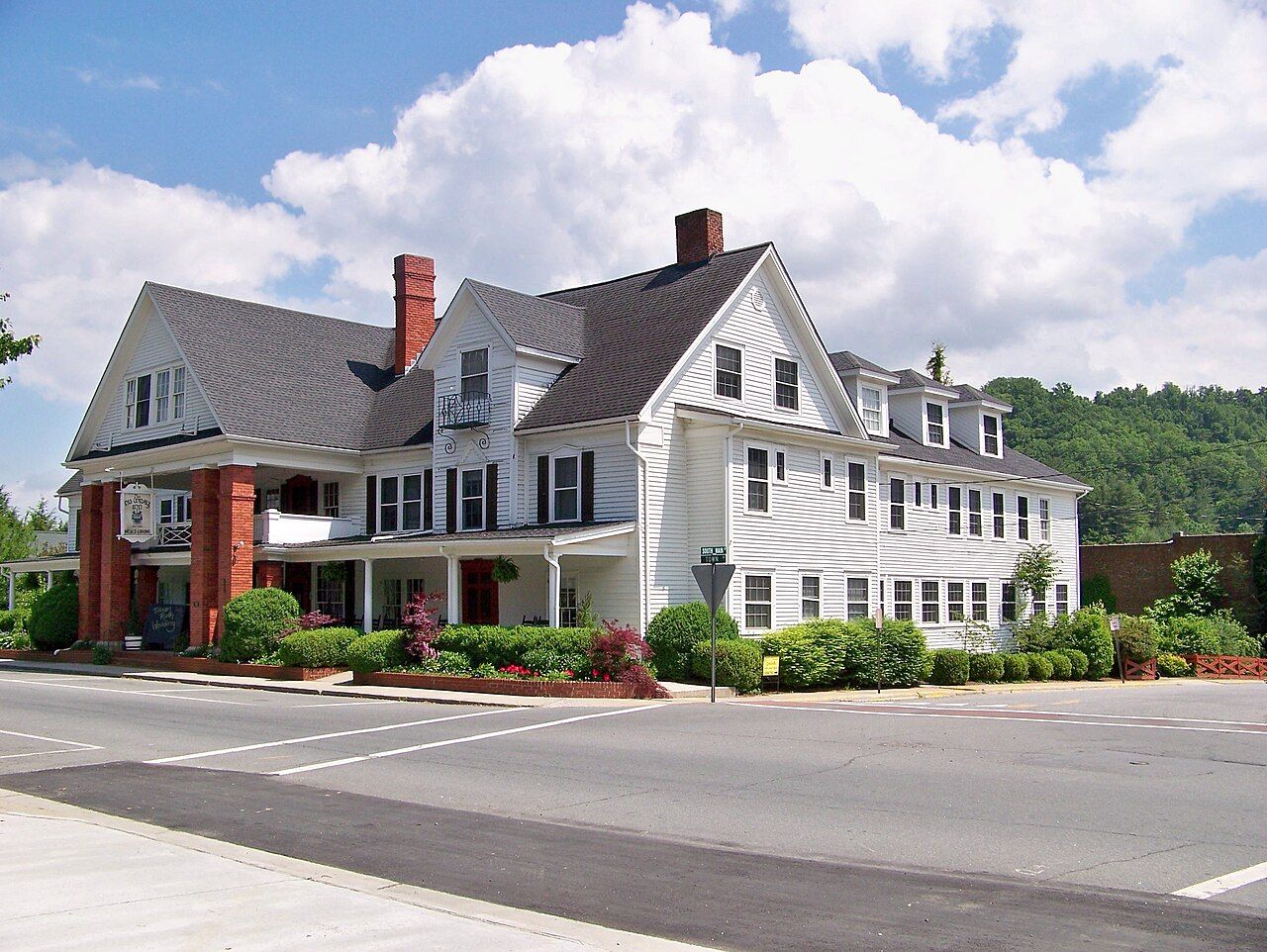
The long frame inn on the Burnsville town green, begun about 1833 when Yancey County was founded, enlarged by the Ray family after the Civil War and given its columned Colonial Revival face by the Wrays in 1915–17.
History
Burnsville was laid out as the seat of the new Yancey County, near Mount Mitchell, in 1833–34, and local tradition holds that Backhaus Smith built an inn on the south side of the town green at about that time. Records are lost, but surviving mantels and raised-panel doors point to a substantial two-story, center-hall house of the 1830s, more finished than most mountain buildings of the day. After the Civil War Garrett and Elizabeth Ray bought it from Milton Penland and more than doubled it, calling it Ray's Inn. The writer Charles Dudley Warner, riding through in the mid-1880s, found a freshly painted, newly enlarged tavern with a long veranda and bedroom floors painted in stripes of green and red, though he had harsh words for the cooking.
After the Rays died in 1912, their daughter Julia, who had married William B. Wray in 1894, bought out her five siblings in 1915. The Wrays rebuilt the inn in the Colonial Revival manner, added electricity in 1917, and renamed it the Nu-Wray. Under them the food became famous: by the 1940s dinner meant some twenty dishes set on the table at once, and Bill Sharpe of The State called it one of the outstanding eating places in the country. Thomas Wolfe stayed in 1929 while covering a murder trial in Burnsville. William died in 1931 and Julia in 1966; their son Rush Wray ran the inn, still seasonal, into the 1980s. New owners bought it in 2021 and began renovation; it served as a base for relief work after Hurricane Helene in 2024.
“The mixture of the interior finish of the various stages of construction encountered through the inn heightens its overall character of informal comfort.”
Architecture
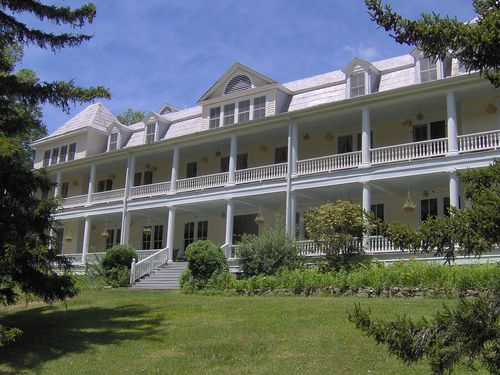
The inn is a long, two-and-a-half-story frame building with a ten-bay front facing the green and an eight-bay rear ell. Its face dates from 1915–17: a monumental gabled portico on pairs of massive brick piers, a full-width one-story porch with turned posts and a roof balustrade, a fanlight over the door and shutters. A projecting three-story gabled bay and triangular window heads survive from the Rays' enlargement of about 1870. The original 1830s house lies within the west end, where three mantels with richly molded shelves and two six-panel doors remain. The Wrays' wide closed-string stair has paneled spandrels and chamfered newels. Behind stand a nineteenth-century frame smokehouse and a small roofed stone well.
What to look for
- Gabled portico on paired brick piers facing the green
- Projecting three-story bay from the 1870s enlargement
- Triangular window heads from the Ray era
- Nineteenth-century smokehouse behind the inn
Setting
The inn faces north across the town green of Burnsville, the Yancey County seat, with the county courthouse and the statue of Captain Otway Burns nearby. The Black Mountains and Mount Mitchell, the highest peak east of the Mississippi, rise to the south. Behind the building, latticework fences screen a back patio, the old smokehouse and the well.
Timeline
- c. 1833Inn built on the new Burnsville town green
- c. 1870Garrett and Elizabeth Ray enlarge it as Ray's Inn
- 1915Julia Ray Wray buys out her siblings
- 1915–1917Colonial Revival remodeling; renamed Nu-Wray Inn
- 1929Thomas Wolfe stays during a murder trial
- 1982Listed on the National Register
- 2021Sold to new owners and renovation begins
Where sources differ
- Wikipedia says the inn was first built of logs with eight bedrooms; the nomination describes a two-story, two-room-deep frame house and gives c. 1833 with a question mark.
- The attribution to Backhaus Smith is local tradition. Stays by O. Henry and Elvis Presley reported by Wikipedia are undocumented.