Tavern · Bardstown, Kentucky · Built traditionally 1779; brick section 19th century
Old Talbott Tavern
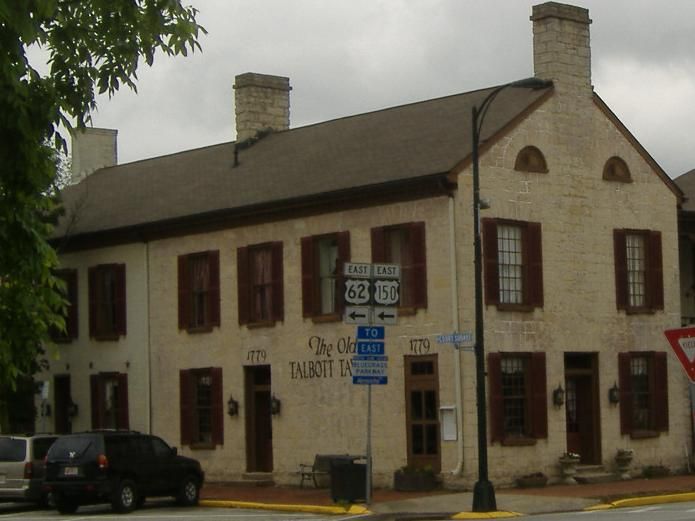
A two-foot-thick stone tavern on Bardstown's Court Square, traditionally dated 1779, at the western end of the stage road from Philadelphia and Virginia; later joined to a parallel brick building by a verandaed link.
History
Bardstown, first called Salem, was laid out around 1780 at a crossing of roads into the Kentucky interior, and the stone tavern on the courthouse square served travelers at the end of the long stage road from Philadelphia and Virginia. Local tradition gives it a 1779 date and says it has never closed. An old town map shows the lot bought by a man named Hynes, and "Hynes Hotel" was once painted on the east wall, which was originally the front. Over the years it was also the Bardstown Hotel, Chapman's House, the Shady Bower Hotel, the Newman House and, under George Talbott, who bought it in 1886, the Talbott Hotel and Talbott Tavern.
The tavern's guest list rests largely on tradition. George Rogers Clark is said to have stored supplies in its cellars for his western campaigns; Andrew Jackson, Henry Clay, William Henry Harrison, the steamboat inventor John Fitch and Stephen Foster, visiting his kinsman at Federal Hill, are all said to have stopped here. Thomas and Nancy Lincoln are said to have stayed while they lost the lawsuit over their farm that sent the family to Indiana. On October 17, 1797, by legend, the exiled Louis-Philippe of France and his brothers arrived, and one of the party painted the murals rediscovered in a guest room in the twentieth century; bullet holes in them are blamed on Jesse James. Queen Marie of Romania lunched here in 1926. A fire on March 7, 1998, badly damaged the roof, second floor and murals, and the building reopened in November 1999.
“Through the welcoming portals of the Old Stone Tavern, passed a long procession of statesmen, soldiers, adventurers, inventors, artists, and rulers.”
Architecture
The oldest part is the eastern section, a two-story stone building four bays wide with two front doors, its walls of solid stone two feet thick, with deep window reveals, heavy ceiling timbers and built-in cupboards. Cooking was done at two fireplaces in the rear rooms, and traces survived of a stair to a loft divided into one room for men and one for women. A similar brick building was later raised parallel to it, about a century after the stone one, and the two were joined by a connecting wing with verandas that holds the present main entrance, so that the street front now shows two gable ends side by side. The 1998 fire led to extensive rebuilding of the upper floor.
What to look for
- Two gable ends, stone and brick, joined by a verandaed link
- Stone walls two feet thick on the eastern section
- Old east wall that once served as the front
- Nelson County jail and courthouse square next door
Setting
The tavern stands on Court Square in the Bardstown Historic District, facing the 1890s Nelson County courthouse at the center of town, with the old Nelson County jail next door. Bardstown's grid of early brick and stone houses surrounds the square, and My Old Kentucky Home State Park at Federal Hill lies just east of town.
Timeline
- 1779Traditional date of the stone tavern
- 1797Louis-Philippe of France said to stay on October 17
- 1886George Talbott buys the tavern
- 1926Queen Marie of Romania lunches here
- 1973Listed on the National Register
- 1998Fire damages the roof, upper floor and murals
- 1999Reopened in November after repairs
Where sources differ
- The 1779 construction date predates the founding of Bardstown and is tradition, not documented; so is the claim that the tavern has never closed.
- Most famous visits, including George Rogers Clark's use of the cellars and the Louis-Philippe murals, are reported as tradition or legend in the nomination. Jesse James's bullet holes and the tavern's ghosts are legend.
- The nomination speaks of Abraham Lincoln's "ancestors" staying during the farm lawsuit; Wikipedia says his parents.