Resort hotel · French Lick, Indiana · Built 1901–1927 (main wing 1901–1902)
French Lick Springs Hotel
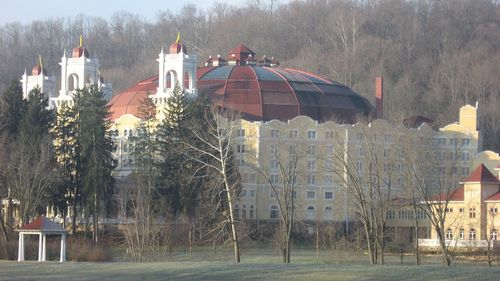
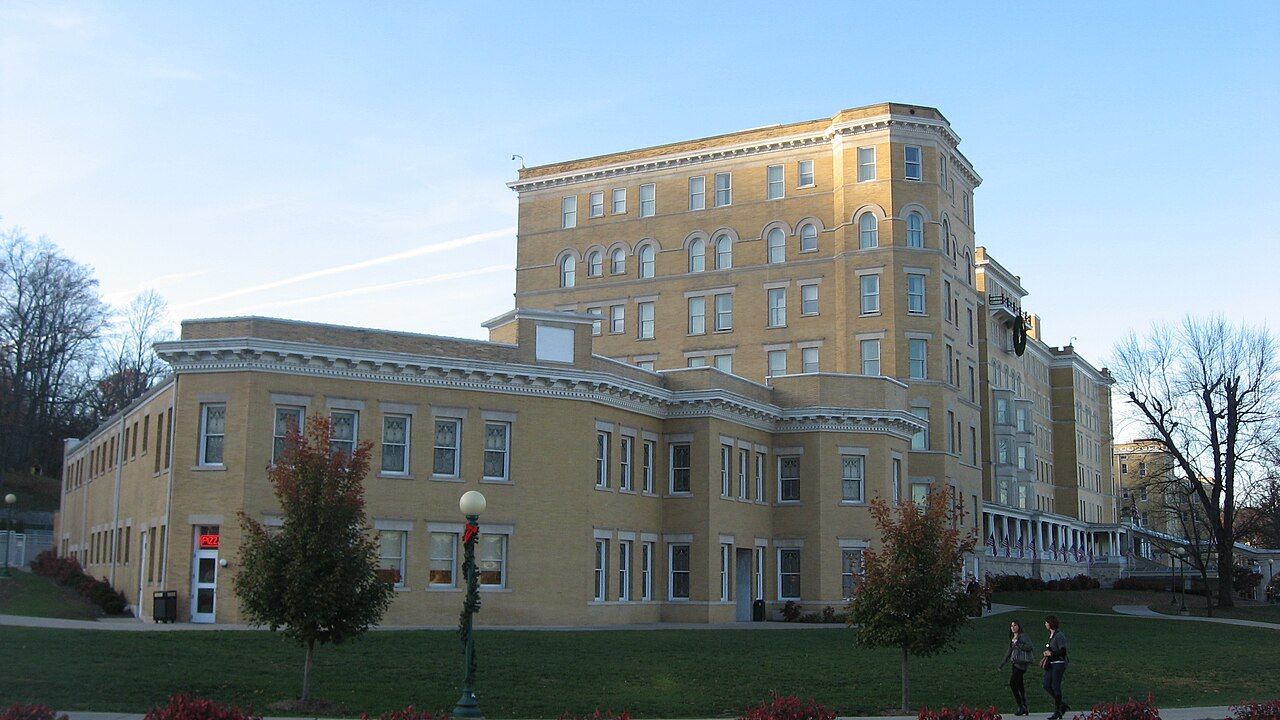
A yellow-brick mineral-springs resort hotel of many connected wings, rebuilt from 1901 by Indianapolis political boss Thomas Taggart around the Pluto spring; its 250-foot veranda faces State Road 56 in French Lick.
History
Salt springs drew buffalo and hunters to this valley long before settlers came, and the state held the land for salt-making until 1833. Dr. William A. Bowles, a Paoli land speculator who would be tried for treason as a Confederate sympathizer in 1864, opened a three-story frame hotel beside one of the springs around 1845. He leased it in 1846 to John A. Lane, a patent-medicine man who went on to start the rival hotel at West Baden a mile north. In 1869 a Madison physician analyzed the water and named the largest spring Pluto's Well; the laxative water sold as Pluto Water made the resort's name. A Louisville company bought the place in the 1880s, the Monon Railroad reached the valley in 1887, and the hotel began staying open all year.
In 1897 the springs briefly stopped flowing and the main building, the Windsor, burned. In 1901 Thomas Taggart, the mayor of Indianapolis and later chairman of the Democratic National Committee, took control with partners including the Monon's president. Their architect, W. Homer Floyd of Terre Haute, enlarged the old hotel and faced it in yellow brick, then added wings through 1927, among them the fireproof West Wing of 1910–11 and a north wing for conventions. Tom Bendelow enlarged the Valley golf course, and Donald Ross's Hill Course hosted the 1924 PGA Championship. Gambling, illegal but tolerated nearby, added to the draw, and Taggart's politics made the hotel a Democratic gathering place.
The Taggart family sold in 1946. Sheraton ran the hotel from 1954 to 1979 and other owners followed. After Indiana allowed a casino here, the hotel was restored and reopened in November 2006 alongside West Baden.
“The hotel is one of a relatively few extant examples nationwide of the remotely located, large-scale resort based on a health amenity.”
Architecture
The main building is laid out on a T-plan as a chain of narrow connected wings, two to seven stories high, stretching some 800 feet along the entry front and holding 471 rooms when nominated. Floyd kept the parts together with a single buff-yellow face brick, a parapeted roofline and classical trim of carved limestone and pressed metal. The 1901–02 styling was a Free Classic variant of Queen Anne; corner towers and the 250-foot white raised veranda survive from it, while later rooms and additions turned toward Italian Renaissance models.
The Pluto spring house of about 1911, faced in glazed brick, and an Italian Renaissance drinking pavilion carry the spa story, and a Craftsman bungalow serves as the Valley course pro shop.
What to look for
- The 250-foot white veranda across the entry front
- Buff-yellow brick unifying wings of 1901–1927
- Pluto spring house and its Italian Renaissance pavilion
- Craftsman bungalow pro shop on the Valley course
- The 1907 railway depot across the road
Setting
The hotel sits at the foot of a ravine opening onto the valley of French Lick Creek, facing east across State Road 56 toward the small town and the 1907 railway depot. The Valley golf course curves away to the north, and the Hill Course lies about two miles south. West Baden Springs Hotel, the old rival, stands a mile up the valley.
Timeline
- c. 1845William A. Bowles opens the first hotel by the springs
- 1869Largest spring named Pluto's Well
- 1887Monon Railroad reaches French Lick
- 1897Main building, the Windsor, burns
- 1901–1902Taggart group rebuilds and enlarges the hotel in yellow brick
- 1946Taggart family sells the hotel
- 2006Restored hotel reopens on November 3 with a new casino
Where sources differ
- The nomination says Bowles bought land at French Lick in 1828; Wikipedia says he and his brother bought 1,500 acres in 1832.
- The exact opening year of Bowles's first hotel is not documented; c. 1845 is the usual date.
- The nomination notes it is unclear whether the 1897 main building was brick before it was enlarged and faced in yellow brick in 1901–02.
- The story that tomato juice was first served here in 1917 is a hotel tradition and is not in the nomination.