Bed-and-breakfast · Charleston, South Carolina · Built 1763; third story 1853
John Rutledge House
Listed on the National Register as Governor John Rutledge House
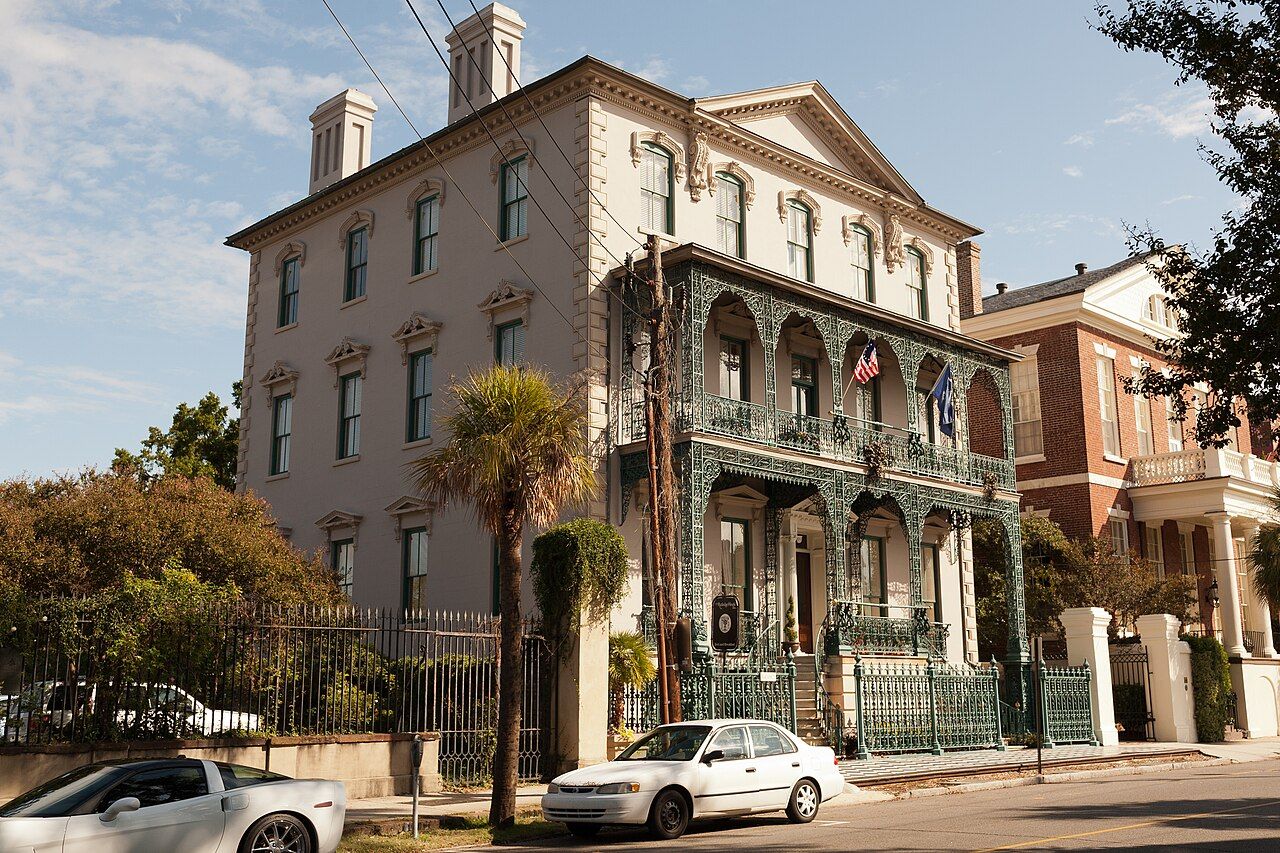
The Broad Street town house that John Rutledge, wartime governor of South Carolina and signer of the Constitution, built in 1763; raised a story and given ornate ironwork in 1853, and opened as an inn in 1989.
History
John Rutledge, born in or near Charleston in 1739, trained at the Middle Temple in London and came home in 1760 to become one of the colony's leading lawyers. He built this two-story brick house on Broad Street in 1763 and lived in it, according to the landmark nomination, until his death in 1800. He chaired the committee of the Stamp Act Congress that drafted its petition to the House of Lords, sat in both Continental Congresses, and was elected president of South Carolina under its 1776 constitution. As governor from 1779 to 1782 he was given near-dictatorial powers during the British siege, slipped out of Charleston before its surrender in 1780, kept partisan resistance alive from North Carolina and restored civil government in 1781–82.
At the Constitutional Convention of 1787 Rutledge chaired the Committee of Detail, argued that wealth should count in apportioning representation, and opposed limits on the slave trade. Washington named him to the first U.S. Supreme Court in 1789; he left in 1791 to become South Carolina's chief justice, and in 1795 presided over one term as Chief Justice of the United States before the Senate refused to confirm him. He was buried at St. Michael's. In 1853 Thomas M. Gadsden added the third story and most of the house's present ornament. For much of the twentieth century the house held law offices, partitioned and given dropped ceilings, until a 1989 renovation reopened it as an inn.
“Partition walls have been inserted and false ceilings installed to adapt the house for use as law offices but no important structural changes have been made to the building.”
Architecture
The house is a large brick block, stuccoed and quoined, about 60 by 44 feet, rising three stories over a raised basement under a slate hipped roof with a front gable and paired chimneys in the side walls. Window heads change by floor: triangular pediments on the first story, broken pediments on the second, and arched hood moldings on the 1853 third story. Across the front runs an elaborate two-story porch of cast and wrought iron, credited to the Charleston ironworker Christopher Werner. Inside, a center hall with a rear stair divides paired rooms, and on the second floor the drawing room and library across the front could be opened into a single ballroom. Original parquet floors survive, with mid-nineteenth-century marble mantels on eight fireplaces.
What to look for
- Two-story cast- and wrought-iron front porch
- Different window heads on each floor
- Corner quoins on the stuccoed brick walls
- Edward Rutledge House across Broad Street
Setting
The house stands on the north side of Broad Street opposite the foot of Orange Street, in the heart of Charleston's old walled city. Across the street is the house of John's brother Edward Rutledge, another signer. St. Michael's Church, where Rutledge is buried, and the Old Exchange are a few blocks east at the Four Corners of Law.
Timeline
- 1763John Rutledge builds the two-story house
- 1779–1782Rutledge serves as wartime governor
- 1787Rutledge signs the U.S. Constitution
- 1800Rutledge dies in Charleston
- 1853Thomas M. Gadsden adds the third story
- 1973Designated a National Historic Landmark
- 1989Renovated and opened as an inn
Where sources differ
- The ironwork's attribution to Christopher Werner is traditional.
- The nomination dates the elaborate iron porch and mantels only broadly; whether the 1763 house had its present stucco and window heads before 1853 is not settled in the sources.