Resort hotel · Mackinac Island, Michigan · Built 1887; additions 1897 and 1912
Grand Hotel
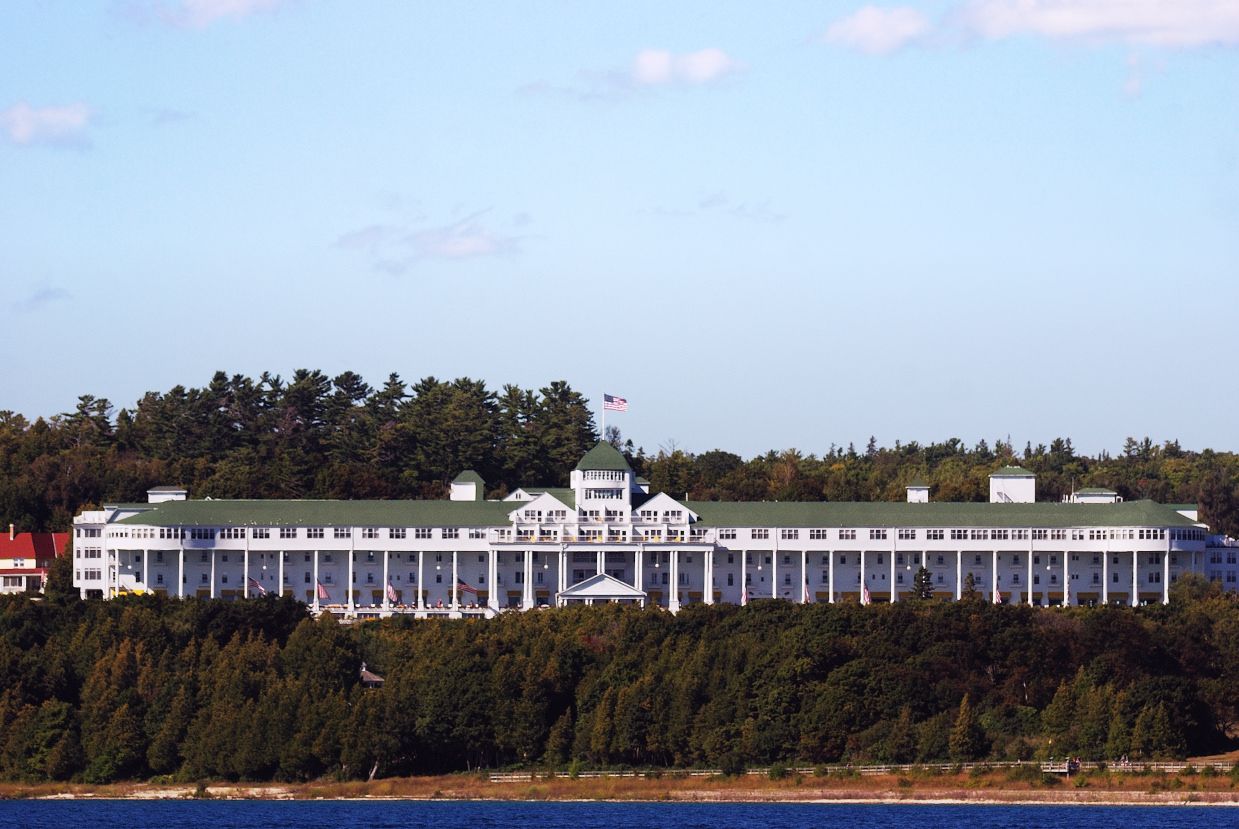
A white clapboard summer hotel of 1887 on a bluff above the Straits of Mackinac, built in about three months by a railroad and steamship partnership and fronted by a columned porch more than 600 feet long.
History
Mackinac Island, once a fur-trade center and the site of a British fort built in 1780, became the country's second national park in 1875, and steamers and railroads pushing north to the Straits brought a stream of summer visitors. The idea of a first-class hotel came from Francis B. Stockbridge, a Michigan legislator who sold the site when he went to the U.S. Senate. Three usually rival carriers, the Michigan Central and Grand Rapids & Indiana railroads and the Detroit & Cleveland Navigation Company, formed the Mackinac Island Hotel Company to build it. The builder Charles W. Caskey cut timber at his own mill in St. Ignace, hauled it across the ice in the winter of 1886–87, and in spring brought over some 300 workers; when key men threatened to strike, he reminded them his boat would not take them home. Using about 1.5 million feet of lumber, he finished in just over three months, and the hotel opened in July 1887 as Plank's Grand Hotel, after its first manager, John Oliver Plank.
Lumber barons, Chicago merchants and brewers filled it in summer at $3 to $5 a day; lectures and demonstrations, including Edison's phonograph, were staged on the porch in the 1890s. J. Stewart Woodfill, who began as a desk clerk in 1919, bought the hotel in 1933, and Dan Musser, a cashier in 1951, bought it in 1979. Films made here include This Time for Keeps (1947), with Esther Williams, and Somewhere in Time (1980). The hotel was designated a National Historic Landmark in 1989.
“The Grand Hotel is not architecturally fussy, as was the fashion, but is rather classic, with its row of Doric columns across the great porch.”
Architecture
The Grand is a five-story white clapboard building running some 900 feet along the bluff, with major additions of 1897 and 1912 and about 286 rooms when documented in the 1980s. Its signature is the deep verandah, given as 628 feet in the nomination and usually advertised at about 660, carried on a long colonnade of Doric columns, with a square cupola on the roof. The nomination calls the design classic rather than fussy. The parlor floor holds a 169-foot parlor overlooking the porch and the Salle à Manger, a dining room more than 200 feet long with a musicians' balcony. Because the hurried foundations settled, the porch was later braced with diagonal trusses in concrete, and its hollow wooden columns now sheath steel supports.
What to look for
- The long porch and its Doric colonnade
- Square rooftop cupola
- Horse-drawn carriages at the entrance
- Salle à Manger with its musicians' balcony
- Victorian cottages on the West Bluff
Setting
The hotel stands on a bluff on the west side of Mackinac Island, looking south across the Straits of Mackinac toward the Mackinac Bridge and the mainland. Lawns, gardens and a swimming pool fall away below the porch. No cars are allowed on the island; visitors arrive by ferry and reach the hotel by horse-drawn carriage. Victorian cottages line the East and West Bluffs nearby, and Fort Mackinac overlooks the harbor.
Timeline
- 1875Mackinac National Park created
- 1886Mackinac Island Hotel Company formed
- 1887Hotel built in about three months; opens in July
- 1897First major addition
- 1933J. Stewart Woodfill buys the hotel
- 1979Dan Musser buys the hotel
- 1989Designated a National Historic Landmark
Where sources differ
- Wikipedia credits the design to the Detroit firm of Mason & Rice; the nomination names only the builder Charles W. Caskey and Alphonse Howe.
- The porch length is given as 628 feet in the nomination and about 660 feet in the hotel's publicity.
- Wikipedia calls the porch event the first public demonstration of Edison's phonograph; the nomination says a local Edison agent demonstrated it there in the 1890s.