Lodge · Grand Marais (vicinity), Minnesota · Built 1928–1929
Naniboujou Lodge
Listed on the National Register as Naniboujou Club Lodge
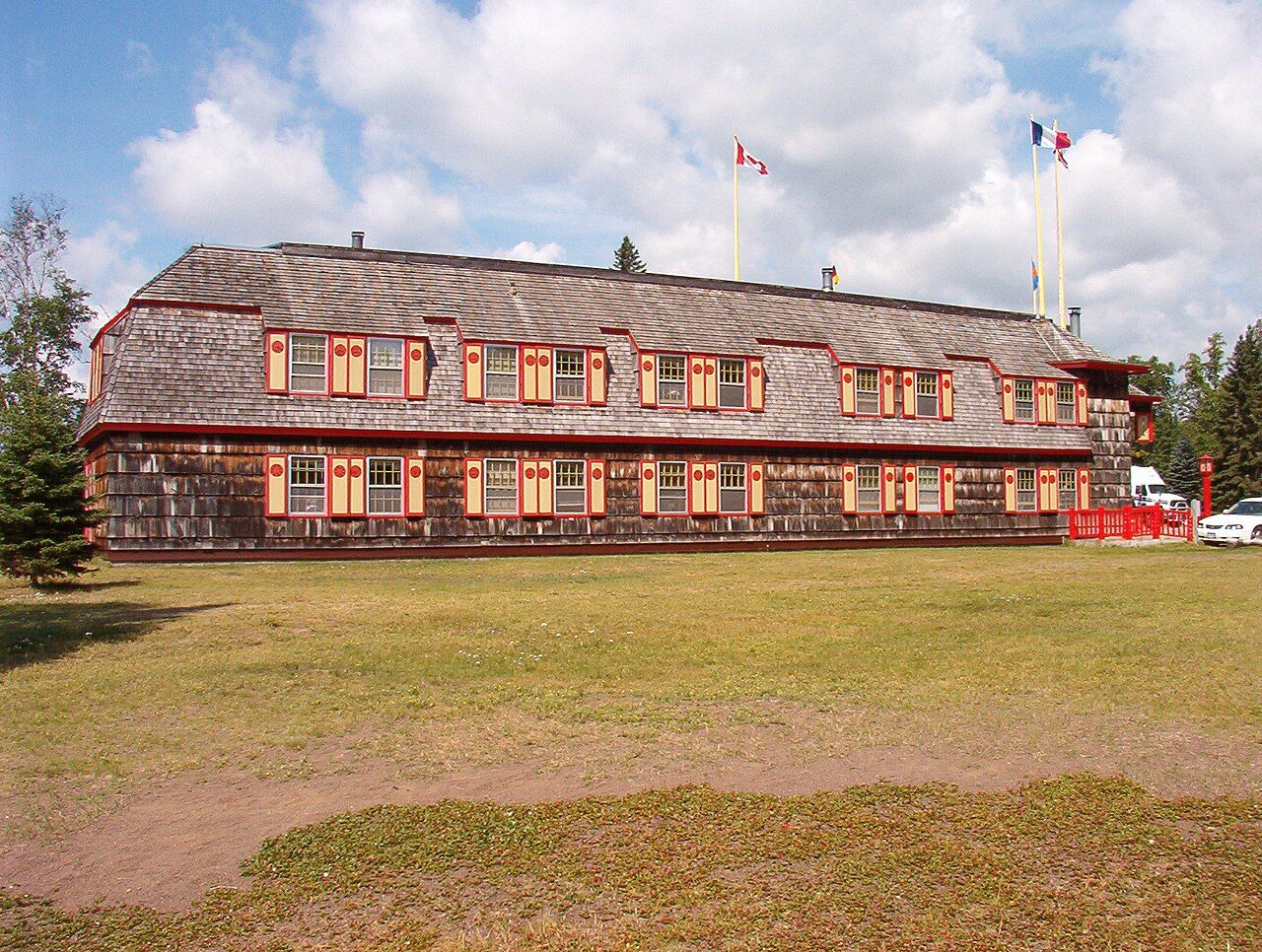
A shingled club lodge of 1928–29 at the mouth of the Brule River on Lake Superior, all that was built of a Duluth syndicate's plan for a private resort; its dining hall is painted floor to ceiling in Cree-inspired patterns.
History
The North Shore highway, finished in the mid-1920s, opened the Minnesota coast of Lake Superior to motorists, and in 1927 a group of 31 Duluth businessmen formed a club to profit from it. Their holding company bought about 3,000 acres at the mouth of the Brule River, which they called the Arrowhead, and took an option on 8,000 more acres of wilderness near the Canadian border. They named the venture for Naniboujou, a spirit of Cree and Ojibwe story said to watch over hunters and travelers on this shore.
The ambitions were large. Holstead and Sullivan of Duluth drew a 150-room clubhouse, a hunting lodge on McFarland Lake, cabins, a pool, tennis courts and an eighteen-hole golf course. The founders hoped for 3,300 members and capped the share from Minnesota at a quarter. Free memberships went to celebrities to lend glamour, and Babe Ruth, Jack Dempsey and Ring Lardner were enrolled. Sales lagged. When the club opened in July 1929 only some 750 memberships had been sold, and what stood was a much reduced lodge of 35 rooms.
The stock market crash came three months later. By 1932 the club had opened its doors to paying non-members, and its finances never recovered; Wikipedia records a foreclosure in 1935, and the nomination says the club closed in 1939, when the property was sold. Most of the inland acreage later became Judge C. R. Magney State Park, while the lodge and its lakeshore stayed private and passed through several owners as a resort.
“Naniboujou Lodge is significant both for its unique design features and as one of northern Minnesota's most elaborately conceived recreational developments.”
Architecture
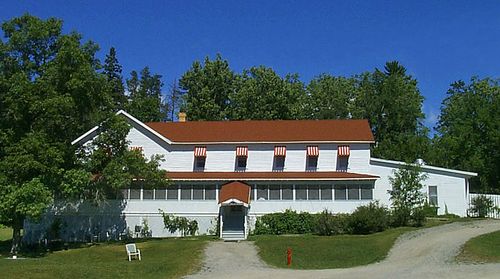
The lodge is a two-story frame building sheathed entirely in natural wood shingles under a dormered gambrel roof. A central block, 30 by 80 feet, holds the great hall, and guest wings run east and west from it; polygonal towers mark the joints. Fourteen pairs of French doors open toward the river, and above them tall windows with sharply pointed heads give the impression of a two-story arcade.
The guest rooms were plain. The money went into the two-story great hall, where the Paris-trained artist Antoine Gouffe painted the walls and ceiling in brilliant zigzags, sunbursts and key patterns drawn from Cree designs, and into a fireplace of rounded lake stones laid in bands and petal shapes, about twelve feet high and estimated at 200 tons.
What to look for
- Painted Cree-inspired ceiling and walls of the great hall
- The 200-ton river-rock fireplace with its sunburst inset
- Polygonal towers where the wings meet the center block
- Pointed second-story windows over the paired French doors
- Mouth of the Brule River beside the lodge
Setting
The lodge sits on about 20 wooded acres between Highway 61 and Lake Superior, on the east bank of the Brule River some 15 miles northeast of Grand Marais. Across the highway, Judge C. R. Magney State Park, carved from the old club lands, follows the river up to the falls and the Devil's Kettle. The surrounding Arrowhead country is largely national forest.
Timeline
- 1927Club formed by 31 Duluth businessmen
- 1928Ground broken at the mouth of the Brule River
- 1929Simplified 35-room lodge opens in July
- 1932Lodge opened to non-members
- 1939Club closes and the property is sold
- 1982Nominated to the National Register
Where sources differ
- Wikipedia gives a foreclosure in 1935 and a sale in 1939; the nomination says only that the club closed in 1939.
- The nomination says the painted motifs were 'said to have been based' on Cree art; how closely they follow Cree designs is not documented.
- The exact National Register listing date is not given in the sources; the nomination was prepared in May 1982.