Hotel · Keosauqua, Iowa · Built 1854 (store and bank); converted and enlarged as a hotel 1890s
Hotel Manning
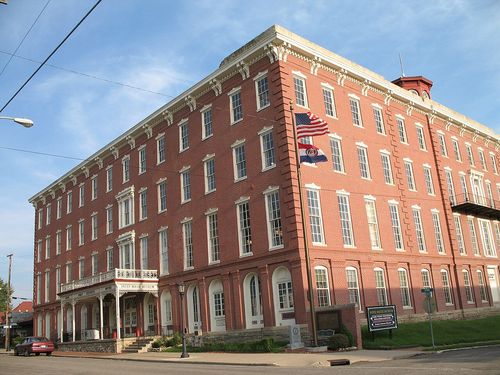
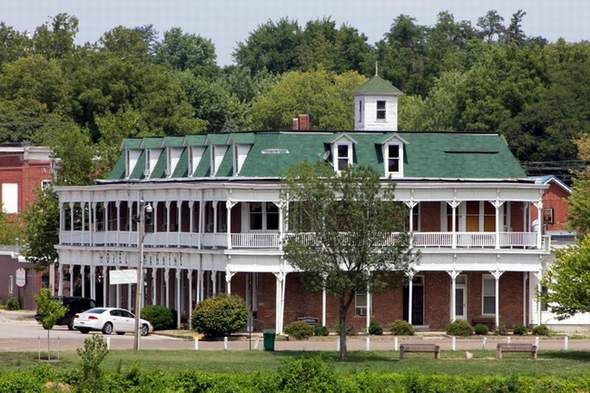
A brick and stone riverfront building at Keosauqua, begun in 1854 as Edwin Manning's store and bank and made a hotel in the 1890s, with tiered verandas and a mansard top in local 'Steamboat Gothic' style.
History
Edwin Manning reached the great horseshoe bend of the Des Moines River in 1837, staked a claim and helped plat the town that became Keosauqua. He returned in 1839 with a boatload of goods from New York and opened a store in a log cabin, and side-wheelers soon ran from the town's landing down to the Mississippi and New Orleans. Manning prospered; in 1854 he built a substantial brick store on stone foundations by the river and added a bank there. The nomination says the building served as general store and bank until 1893, when a floor was added and it was remodeled into a hotel. Wikipedia tells it differently: fires in the mid-1890s damaged the store, and at a son's urging Manning built the hotel on the surviving walls and foundation, adding upper floors between 1897 and 1899 and holding a grand opening for some 300 guests on April 27, 1899. Manning died in 1901.
The family ran the hotel into the 1920s, when farm hard times pushed the Manning bank into receivership and the hotel was sold. Later owners included Bertha Myers and Edgar and Mable Miller, who ran it from the 1940s, largely as a boarding house, and added a motel annex in the 1960s. The river flooded the lobby repeatedly; in 1947 water stood 32 inches deep on the first floor and guests reached the second floor by boat via the fire escape. Promoted for tourism, the hotel was listed on the National Register in 1973 and restored with federal help, and a group of about seventy local investors bought it in 2018.
“It is felt that the design was borrowed from his trips down to New Orleans, since it looks as though it were transplanted from the south.”
Architecture
The building is about 115 by 50 feet, with stone basement walls up to two feet thick, a ground floor of sixteen-inch brick and a second floor of twelve-inch brick. Its riverboat look, called Steamboat Gothic in local tradition, comes from tiers of long verandas across the main fronts, the uppermost dating from the 1890s remodeling, and a third floor treated as a French mansard on the two principal facades; a captain's walk once crowned the roof. The nomination suggests Manning borrowed the design from buildings he saw on trips to New Orleans. Glass panes in the front doors were etched with an M that served each owning family. Inside, the lobby and guest rooms were later furnished with period antiques.
What to look for
- Tiered verandas facing the river
- Mansard third floor on the two main fronts
- Thick stone and brick walls of the 1854 store
- Front door panes etched with an M
- Flood-level history along the riverbank
Setting
The hotel stands on the riverbank in Keosauqua, a small county seat inside a sweeping horseshoe bend of the Des Moines River in southeastern Iowa. The 1840s Van Buren County Courthouse, among the oldest in the state, is a few blocks away, and Lacey-Keosauqua State Park lies across the river. The villages of Bentonsport and Bonaparte are downstream.
Timeline
- 1837Edwin Manning arrives at the bend of the Des Moines River
- 1854Brick store and bank built on the riverfront
- 1890sConverted and enlarged into the Hotel Manning
- 1899Grand opening on April 27, per Wikipedia
- 1947Two floods a week apart inundate the first floor
- 1973Listed on the National Register
- 2018Bought by a group of local investors
Where sources differ
- The nomination dates the conversion to a hotel to 1893; Wikipedia says the hotel was built on fire-damaged walls in 1897–99 and opened in 1899.
- The floods are listed as 1903, 1905 and 1947 in the nomination; Wikipedia names 1901 as the worst.
- 'Steamboat Gothic' is a local label; the New Orleans inspiration is presented in the nomination as an opinion. The nomination's account of ownership differs in detail from Wikipedia's.