Lighthouse · Big Bay (vicinity), Michigan · Built 1896
Big Bay Point Lighthouse
Listed on the National Register as Big Bay Point Light Station
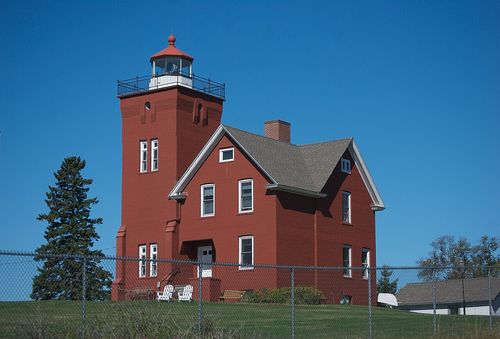
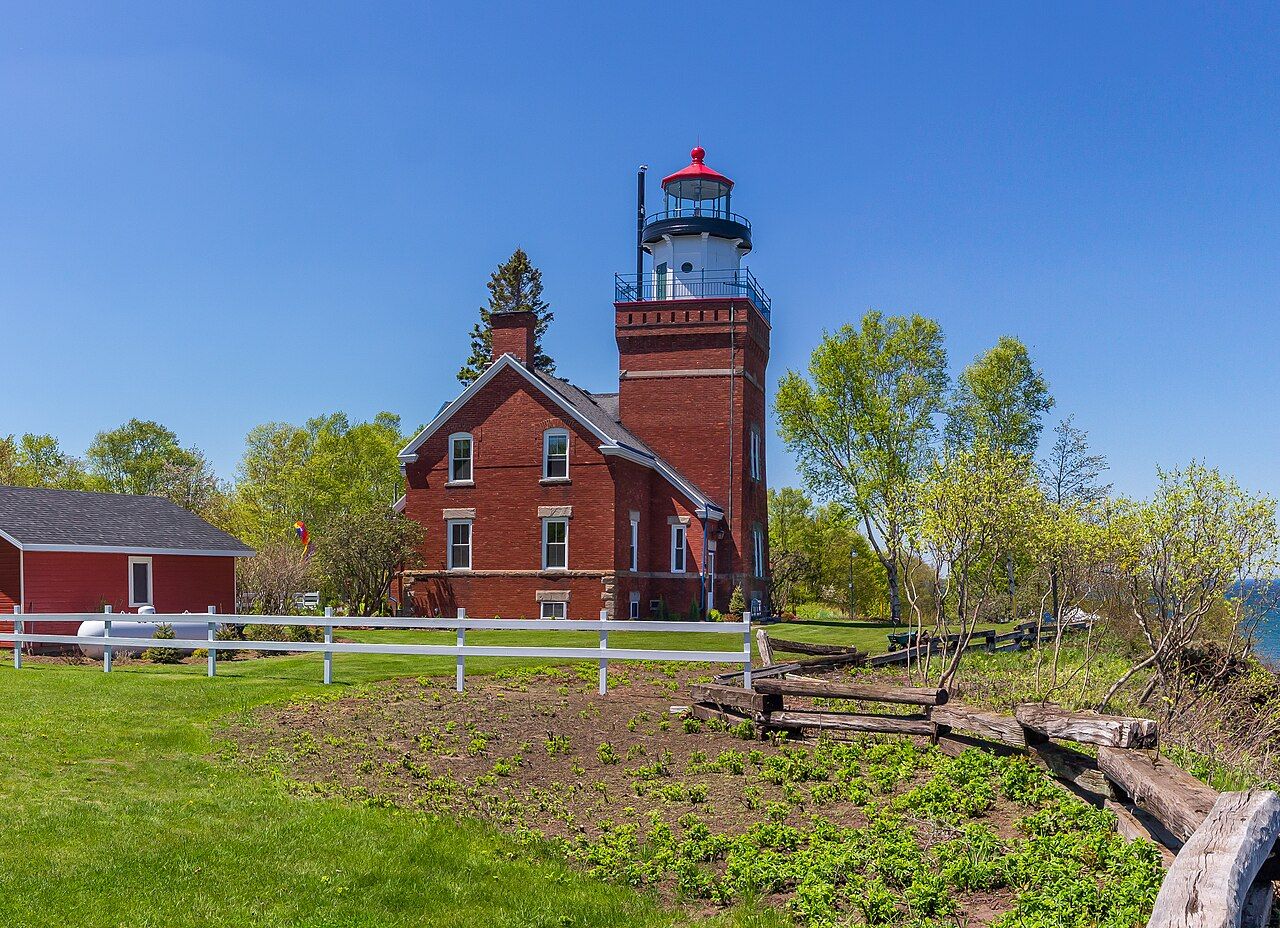
A red-brick double keepers' house and square tower of 1896 on a sixty-foot bluff above Lake Superior northwest of Marquette; automated in 1941, sold in 1961, and a bed-and-breakfast since 1986.
History
In 1892 the Lighthouse Board pointed out that the shore between the Granite Island and Huron Island lights, fifteen to eighteen miles each way, was dark, though every passenger steamer bound for Marquette and the copper ports passed it, and that ships had been wrecked on Big Bay Point. Congress authorized a station in 1893 and appropriated $25,000 the next year; the site was bought from the Keweenaw Association in 1895, and the district engineer's office in Detroit drew plans that winter. Work began in June 1896, and the light, 108 feet above the lake, was first shown on October 20, 1896, with a ten-inch steam whistle for fog. A keeper and an assistant lived here with their families in a divided house. The first keeper, William Prior, hanged himself in the woods a mile from the station in 1902, and the story of his ghost has clung to the place since.
An air diaphone replaced the steam whistle in 1928, and the station was automated in 1941. After two decades of neglect the Coast Guard built a new light tower elsewhere on the point in 1961 and auctioned the station to Dr. John Pick, who in 1962–64 joined the two apartments into one summer home, adding a fireplace, modern kitchen and common foyer. Norman Gotschall bought the property in 1986 and opened it as a five-room bed-and-breakfast; bathrooms were added in 1987, the original lens was brought back to the tower, and the station was listed on the National Register in 1988.
“Big Bay Point was in many ways typical of the light stations at isolated locations along the Great Lakes coastline of Michigan.”
Architecture
The keepers' dwelling is a two-story red-brick building on a stone foundation, a flattened T in plan with cross-gabled roofs, up to 52 feet on a side. Built as two reverse-plan apartments side by side, each with its own entrances and staircases, it had a second-floor room used as a chapel and a first-floor room for schooling and Coast Guard business. The square brick tower, about 45 feet tall, rises on the lake side, with corbelled brickwork near the top below a round steel-plate watch room and lantern. Around it stand a hip-roofed brick fog signal house of 1896, a small brick oil house, matching brick privies, a frame garage and a concrete pier of about 1898 below the bluff. The nomination calls the group typical Lighthouse Establishment Late Victorian vernacular.
What to look for
- Corbelled brickwork below the lantern
- The doubled plan of the keepers' house
- Hip-roofed brick fog signal house of 1896
- Matching brick privies and the tiny oil house
- The 1961 steel light tower on the point
Setting
The station sits on a grassy clearing atop a rocky bluff at the tip of a small peninsula about three miles northeast of the hamlet of Big Bay and some 23 miles northwest of Marquette, reached by a private road through woods. On clear days the Keweenaw Peninsula is visible thirty-five miles away. The steel skeleton tower that replaced the old light stands nearby on the point.
Timeline
- 1892Lighthouse Board recommends a station at Big Bay Point
- 1896Light first exhibited on October 20
- 1928Steam whistle replaced by an air diaphone
- 1941Light automated
- 1961Sold at auction to Dr. John Pick after a new tower is built
- 1986Norman Gotschall buys it and opens a bed-and-breakfast
- 1988Listed on the National Register
Where sources differ
- Wikipedia dates the recommendation for the station to 1882 and says Prior disappeared in 1901; the nomination gives 1892 and says he hanged himself in 1902.
- Wikipedia says Dan Hitchens owned the property between Pick and Gotschall and that the bed-and-breakfast opened in 1986; the nomination does not mention Hitchens.
- Accounts differ on the original lens: the nomination says it was put back in the tower, while another source says it went on loan to the Marquette Maritime Museum.
- The haunting by the first keeper is local legend.