Hotel · Essex, Montana · Built 1939
Izaak Walton Inn
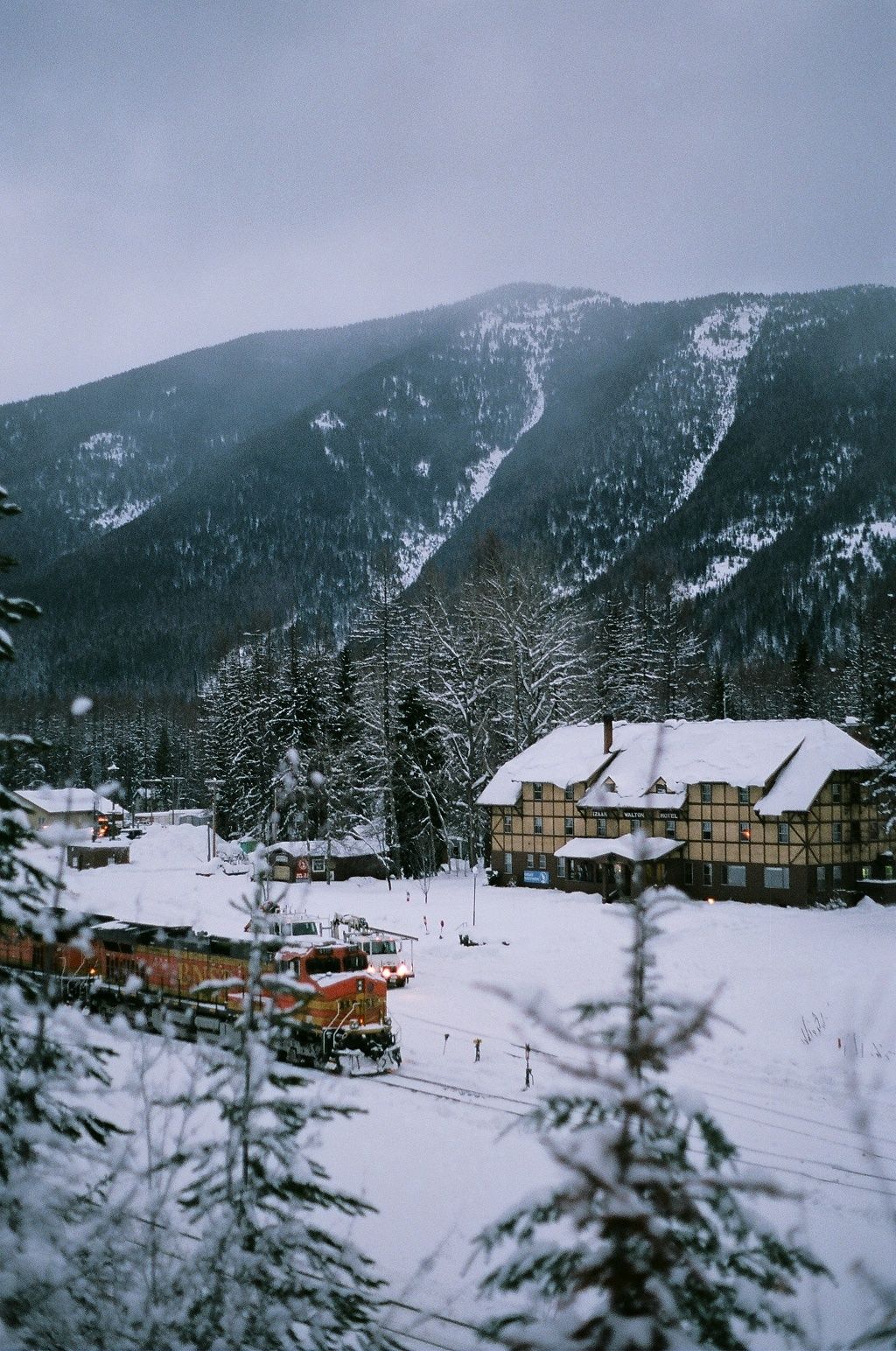
A half-timbered railroad hotel of 1939 beside the Great Northern main line at Essex, built to house the snow crews who kept Marias Pass open and to catch summer anglers and Glacier Park motorists.
History
Essex sits on the steepest grade of the Great Northern's transcontinental line, eighteen miles west of the Continental Divide at Marias Pass. Every winter the railroad stationed helper engines, snow-clearing gangs and their officers there, and for decades the men slept in old boxcars, wall tents and shacks. Two company beaneries on the site fed them but offered no beds; the first burned in 1918 and the second in August 1935. After repeated petitions from workers, and a 1937 letter from Whitefish superintendent I. E. Manion asking for room for six five-man crews at once, the railroad agreed to build a hotel. Designed by the company architect Thomas McMahon and put up by the Addison Miller Company, it took twelve carpenters three months and cost about $40,000. It opened on November 15, 1939, with 29 guest rooms, a lobby, dining room, store and a basement bar.
The name honored Izaak Walton, author of The Compleat Angler; the town itself had been called Walton. The name and the styling suggest the railroad also hoped for summer fishermen and tourists, and with U.S. Highway 2 newly opened over the pass, the inn became the only year-round lodging on the southern edge of Glacier National Park. A concessionaire ran it for the railroad until private owners bought it in the 1950s; tourist use grew while train crews kept stopping, and Amtrak's Empire Builder made Essex a flag stop. The inn was listed on the National Register in 1985. LOGE, which bought it in December 2022, closed the inn in March 2026 and put it up for sale.
“Prior to the construction of the Inn, seasonal and full-time workers were housed in abandoned railroad cars, wall tents, and other temporary forms of shelter.”
Architecture
The inn is a rectangular two-and-a-half-story frame building on a concrete foundation. The first floor is clad in wide bevel siding, and the upper walls in mock half-timbering with rough stucco infill, the Craftsman-Tudor mix the Great Northern used for its Montana depots of the 1920s and 1930s. A large clipped-gable roof with broad shed dormers overhangs on decorative knee braces. Entrances face both the town and the tracks under small shed-roofed porches with gable pediments. A massive exterior boiler chimney rises on the east side, and an interior chimney serves the lobby's stone fireplace. Inside, knotty-pine paneling lines the halls, and the original layout of guest rooms with shared hall bathrooms was intact at listing.
What to look for
- Half-timbering and stucco above bevel-sided lower walls
- Clipped-gable roof on carved knee braces
- Twin entrances facing the town and the tracks
- Stone fireplace in the lobby
- The rail yard and helper-engine tracks beside the inn
Setting
The inn stands just east of the main line in the tiny railroad town of Essex, in the Middle Fork Flathead River canyon off U.S. Highway 2, on the southern boundary of Glacier National Park. Freight trains still climb toward Marias Pass past the front door, and the river and the park's backcountry lie close by.
Timeline
- 1910First railroad beanery built on the site
- 1935Second beanery burns in August
- 1937Superintendent Manion urges a hotel at Essex
- 1939Inn opens on November 15
- 1950sSold to private owners
- 1985Listed on the National Register
- 2026Closed in March by owner LOGE and listed for sale
Where sources differ
- Wikipedia credits construction to the Addison Miller company and calls the style Tudor Revival; the nomination names Thomas McMahon as designer and describes the styling as Craftsman.
- Wikipedia's claim that the hotel was meant as a southern gateway to Glacier National Park is not in the nomination.
- Essex's population is given as about 400 in the 1920s by Wikipedia and about 150 in 1939 by the nomination.