Resort hotel · Glacier National Park (Many Glacier), Montana · Built 1914–1915; south annex 1917
Many Glacier Hotel
Listed on the National Register as Many Glacier Hotel Historic District
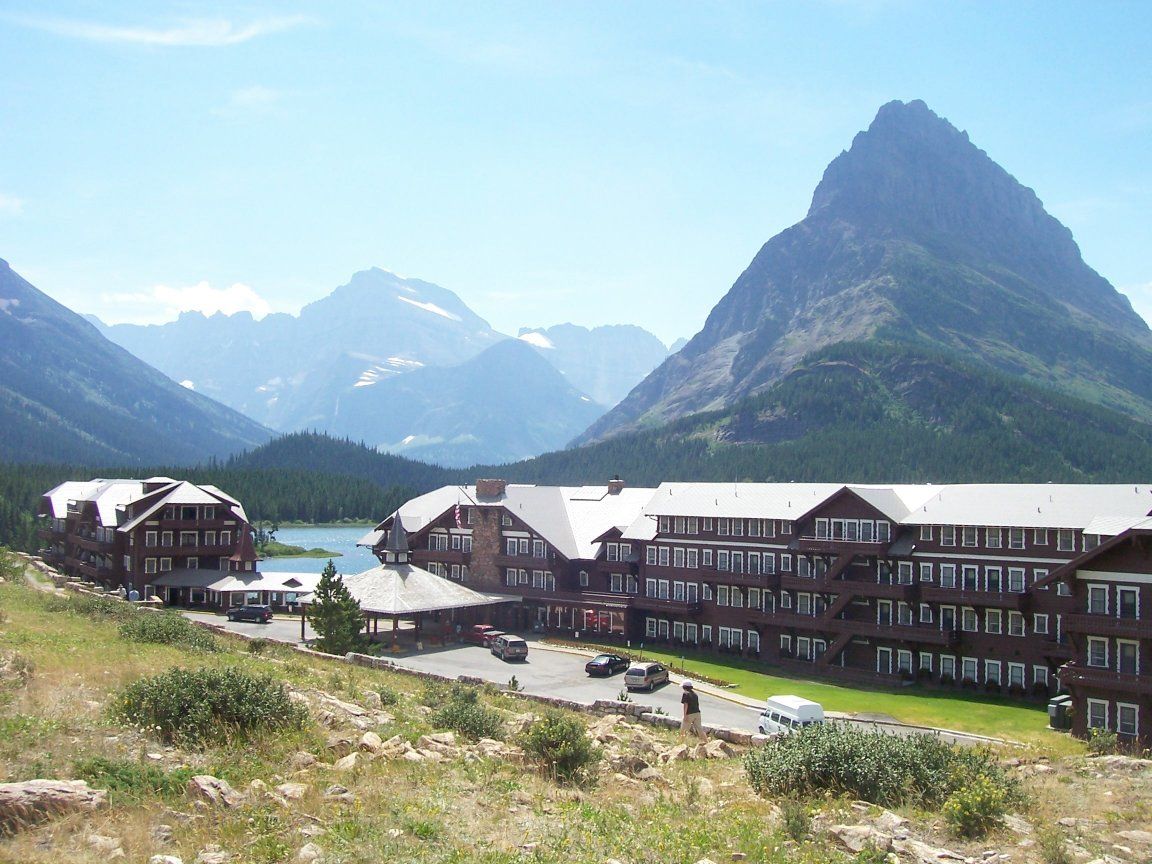
The Great Northern Railway's Swiss-chalet hotel of 1914–15 on Swiftcurrent Lake in Glacier National Park, a 760-foot chain of clapboarded wings around a four-story lobby framed in whole logs.
History
Louis W. Hill, president of the Great Northern Railway, set out to sell Glacier National Park as the American Alps. Visitors would arrive by train at the company's lodge at Midvale, now East Glacier, and ride on to Swiss-style hotels and backcountry chalets spaced a day's hike or horseback ride apart. Many Glacier, where the Swiftcurrent and Grinnell valleys meet, was to be the centerpiece. The railroad built a road from St. Mary, set up a sawmill and a stone quarry on site, and employed some 400 men under contractor E. V. Evensta over two short building seasons. Window sash and other freight came by wagon from Midvale, a five-day trip. The hotel opened in 1915 at a cost of about $500,000, and a second annex followed in 1917.
Hill mixed his themes freely. The lobby was hung with bearskins, buffalo heads and a 180-foot painted canvas of Blackfeet history by Medicine Owl and other chiefs, while staff wore Swiss costume and, by one account, a Japanese couple served afternoon tea on the porches beneath Japanese lanterns. Amenities included steam heat, telephones, a barbershop, a tailor and a small hospital. The railroad's hotel company operated the building for decades. A 1957 remodeling added the porte-cochere and new kitchens and bathrooms, and removed the lobby's double spiral stair to make room for a gift shop below. The hotel district was listed on the National Register in 1976, and the Great Northern buildings in the park were later made a National Historic Landmark.
“Construction was accomplished at a time when travel to the park was still primitive, when visiting the park was a true adventure, and when a park visitor was a wilderness traveler.”
Architecture
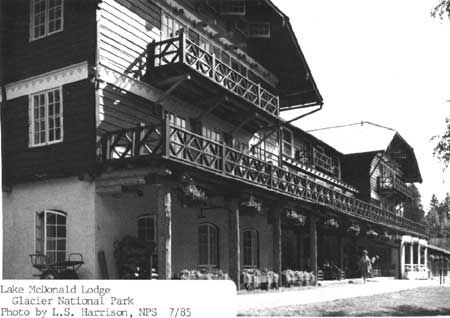
The hotel stretches more than 760 feet along the east shore of Swiftcurrent Lake as a string of frame chalets up to four and a half stories high, linked on an irregular plan. Local stone forms the foundations, the lakeside terrace with its arched basement doors, and the big chimney on the entrance front. Dark brown clapboards set off white and yellow jigsaw-cut trim around windows and doors, and bracketed balconies and galleries with cut-out balusters project from every face under cedar-shingled clipped-gable roofs. The lobby is the showpiece: a four-story space ringed by balustraded balconies and catwalks resting on massive logs treated as giant columns, with a hooded open firepit and tall windows toward the lake.
What to look for
- Jigsaw-cut balcony balusters on the lake front
- The four-story log-columned lobby and its open firepit
- Stone terrace with arched basement doorways
- Timber trail overpasses over the access road
Setting
The hotel sits on a terrace above Swiftcurrent Lake in the Many Glacier valley on the park's east side, reached by a spur road from Babb. Grinnell Point and Mount Gould rise across the water, and trails start nearby for Grinnell Glacier, Iceberg Lake and Ptarmigan Falls. Stone-and-timber trail overpasses and the old employee dormitories belong to the historic district.
Timeline
- 1914Construction begins at Swiftcurrent Lake
- 1915Hotel opens
- 1917Four-and-a-half-story south annex completed
- 1957Porte-cochere added; lobby spiral stair removed
- 1976Listed on the National Register as a historic district
- 1996District documentation expanded to cover grounds and outbuildings
Where sources differ
- The nomination names the architect only as 'McMahon' of St. Paul; the full name Thomas D. McMahon is from other accounts of the Great Northern buildings.
- Wikipedia gives a completion date of July 4, 1915; the nomination says only that construction ran from 1914 to 1915.
- The account of Japanese tea service and lanterns comes from a 1970 park history quoted in the nomination.