Resort hotel · Yellowstone National Park, Wyoming · Built 1889–1891; remodeled 1903–1904; additions 1922–1928
Lake Yellowstone Hotel
Listed on the National Register as Lake Hotel
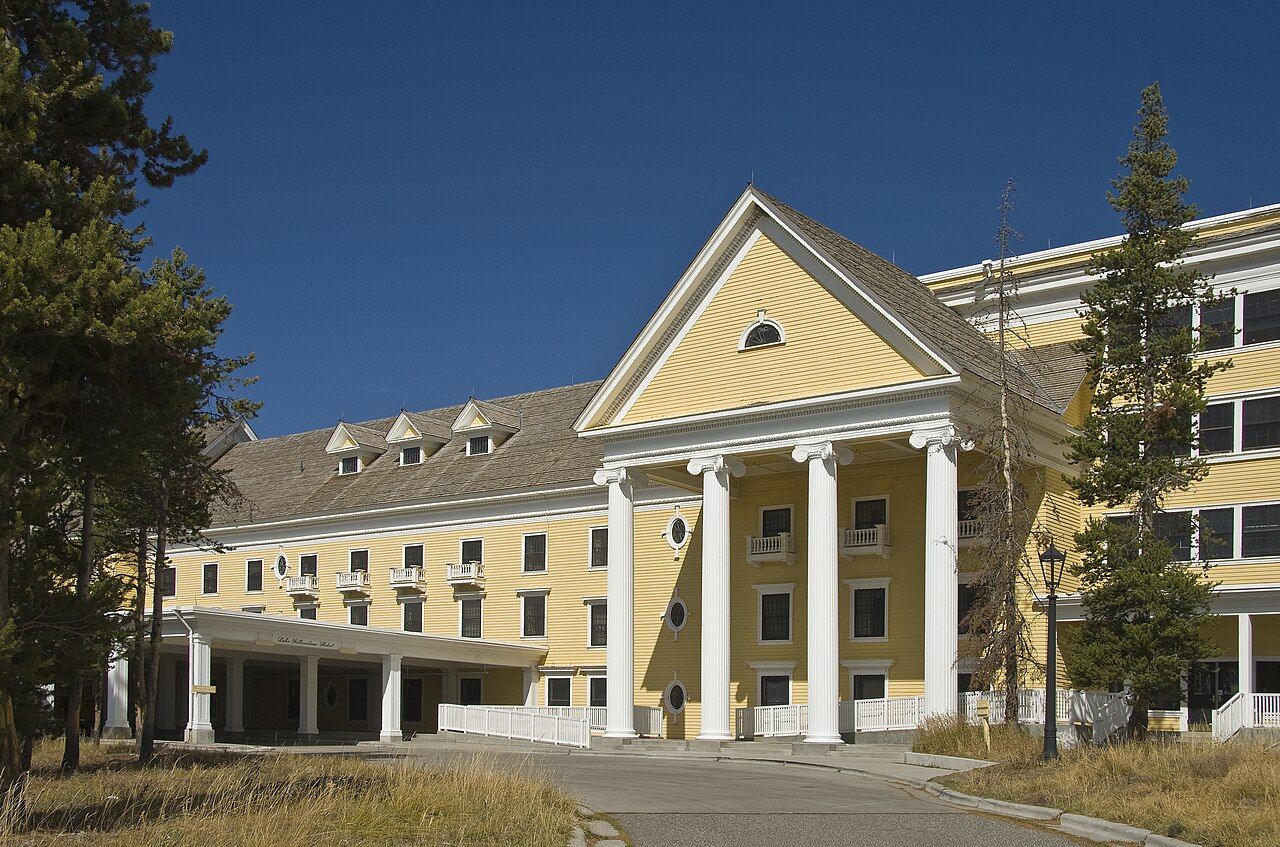
A yellow clapboarded hotel on the north shore of Yellowstone Lake, opened in 1891 as a plain railroad-company building and turned by Robert Reamer from 1903 into a Colonial Revival composition with three-story Ionic porticoes.
History
In 1886 the Yellowstone Park Association, controlled by the Northern Pacific Railroad, won a lease to build hotels at four sites in the park, one of them on the north shore of Yellowstone Lake. Remoteness, a lack of labor and materials, and forest fires held the work back; the park cut the lease to a single acre over the delays. The hotel finally opened in 1891, a barracks-like three-story frame block with a shallow pavilion at each end of its front. Early visitors often arrived by boat across the lake from West Thumb.
The railroad sold the association in 1899 to the Montana banker Harry W. Child, who brought in Robert Reamer, already at work on the Old Faithful Inn. Reamer's 1903–04 remodeling went in the opposite direction from his log inn: he dressed the plain building in Colonial Revival detail, set full-height Roman Ionic porticoes in front of the end pavilions, and added an east wing with a third portico. The opening of the road from Cody and the first Fishing Bridge brought more traffic. A longer east wing with a round Tuscan portico followed in 1922–23, and in 1928 Reamer added the solarium, doubled the dining room with a west wing and extended the lobby.
As tastes changed the hotel came to be seen as an anachronism; it was threatened at least twice with demolition and neglected in the 1960s and 1970s. The Park Service and the concessioner restored and rehabilitated it between 1984 and 1990, the National Register listing followed in 1991, and it was named a National Historic Landmark in 2015.
“As the hotel's status declined during the twentieth century, it was threatened at least twice with demolition, and was abused during the 1960's and 1970's as an anachronism.”
Architecture
The hotel presents a facade some 700 feet long to the lake: narrow yellow clapboards, white trim, three-story porticoes of fluted Ionic columns carrying pediments with lunette windows, and a semicircular Tuscan portico on the flat-roofed east wing. Balconies on carved consoles, bull's-eye windows, architrave trim and pedimented dormers fill in the classical vocabulary. Inside, the registration lobby and main lobby have square columns on paneled pedestals; a green-tile fireplace and an elk-motif drinking fountain, reputedly designed by Reamer and made by Ernest Batchelder's Los Angeles shop, survive. The solarium's walls of glass face the water, and the stair between the second and third floors keeps its 1891 Queen Anne spool balusters.
What to look for
- Three-story Ionic porticoes on the lake front
- Bull's-eye windows on the old east wing
- The 1928 glass-walled solarium
- Batchelder tile fireplace and elk drinking fountain in the lobby
- Spool-turned 1891 balusters on the upper stair
Setting
The hotel faces south across a broad lawn to Yellowstone Lake, near Lake Village and a short distance from Fishing Bridge and the historic fish hatchery. The Absaroka Range rises beyond the far shore. Cabins of later date sit behind the hotel, and the Grand Loop Road passes close by.
Timeline
- 1886Yellowstone Park Association leases the lakeshore site
- 1891Hotel opens
- 1903–1904Reamer's Colonial Revival remodeling and first east wing
- 1922–1923New east wing with semicircular portico
- 1928Solarium, west dining wing and lobby extension
- 1984–1990Restoration and rehabilitation
- 2015Designated a National Historic Landmark
Where sources differ
- Wikipedia dates the flat-roofed east wing extension to 1928; the nomination dates the new East Wing to 1922–23 and the solarium and west wing to 1928.
- The construction start year is not given precisely; the lease dates from 1886 and work was under way before 1891.
- The nomination says the lobby tile work was 'reputedly' designed by Reamer.