Lodge · Glacier National Park (Lake McDonald), Montana · Built 1913–1914
Lake McDonald Lodge
Listed on the National Register as Lake McDonald Lodge (Lewis Glacier Hotel)
A Swiss-chalet hotel of 1913–14 on Lake McDonald, built by private owner John Lewis to rival the Great Northern's park hotels; its three-story lobby of bark-on cedar columns faces the lake that early guests arrived across.
History
Before Glacier became a national park in 1910, George Snyder had built a hotel at this spot on the east shore of Lake McDonald in 1895, reached by carriage, ferry and a ten-mile steamboat run up the lake. John E. Lewis, a land speculator from Columbia Falls, bought the property in the mid-1900s. As the Great Northern Railway filled the new park with chalet hotels, Lewis decided he needed something comparable, 'something worthy of the park', and in 1913 hired the Spokane firm of Kirtland Cutter and Karl Malmgren. Foundations were finished before winter, and work went on for ten months; materials came in by boat in summer and were skidded across the frozen lake in winter. The Lewis Glacier Hotel opened in June 1914. Lewis, who trapped and hunted in the area, hung his own trophies in the lobby, and Charles M. Russell is said to have scratched pictographs into the dining-room hearth during visits in the 1920s.
A road reached the lodge around 1920, and with the later Going-to-the-Sun Road, guests began arriving at what had been the back door. The Great Northern's Glacier Park Hotel Company bought the hotel in 1930 and in 1957 renamed it Lake McDonald Lodge. A 1964 flash flood on Snyder Creek wrecked the dining-room fireplace and the Russell etchings. The lodge district was listed on the National Register in 1978, the lodge was made a National Historic Landmark in 1987, and a 1988–89 renovation restored details lost over the years.
“Building materials were transported to the site by boat during the summer months and skidded across the ice during the harsh winter.”
Architecture
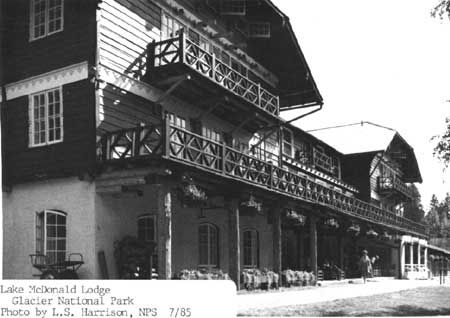
The lodge stands three and a half stories, with stone foundations and first-floor walls, now stuccoed white, and brown clapboarded frame above, banded with painted jigsawn trim. Clipped gables cross the main roof at both ends, and balconies and verandas wrap the upper floors; on the lake side the porch is log post-and-beam with the bark left on. The lobby rises three stories, with trios of tall cedar columns in each corner topped by round log capitals, log-railed balconies on three sides, and a huge inglenook fireplace with painted Indian designs. Its concrete floor is scored to look like flagstone and incised with phrases in Blackfeet, Chippewa and Cree. The lower dining and kitchen wings may incorporate earlier buildings.
What to look for
- Trios of bark-on cedar columns in the lobby corners
- Concrete lobby floor incised with Native-language phrases
- Inglenook fireplace with painted designs
- The lake-facing front and log post-and-beam veranda
- John Lewis's mounted trophies
Setting
The lodge sits on a small rise at the head of Lake McDonald, the largest lake in Glacier National Park, along the Going-to-the-Sun Road about ten miles from the West Glacier entrance. Its true front faces the water and a boat dock, while road traffic comes to the plainer east side. Cabins and a motor inn of the historic district stand nearby among cedars.
Timeline
- 1895George Snyder builds the first hotel on the site
- 1913John Lewis hires Cutter & Malmgren; construction begins
- 1914Lewis Glacier Hotel opens in June
- 1930Great Northern's hotel company buys the lodge
- 1957Renamed Lake McDonald Lodge
- 1964Flash flood destroys the dining-room fireplace
- 1987Designated a National Historic Landmark
Where sources differ
- Wikipedia says Lewis bought the land in 1904–05; the nomination says 1906.
- The nomination places the lobby fireplace on the east wall; Wikipedia says the south wall.
- Russell's carvings in the hearth are a claim that cannot now be checked, since the flood destroyed the fireplace.
- The second partner's name appears as Malmgram, Malmbren and Malmgren in the sources.