Resort hotel · Excelsior Springs, Missouri · Built 1910–1912
The Elms Hotel & Spa
Listed on the National Register as Elms Hotel
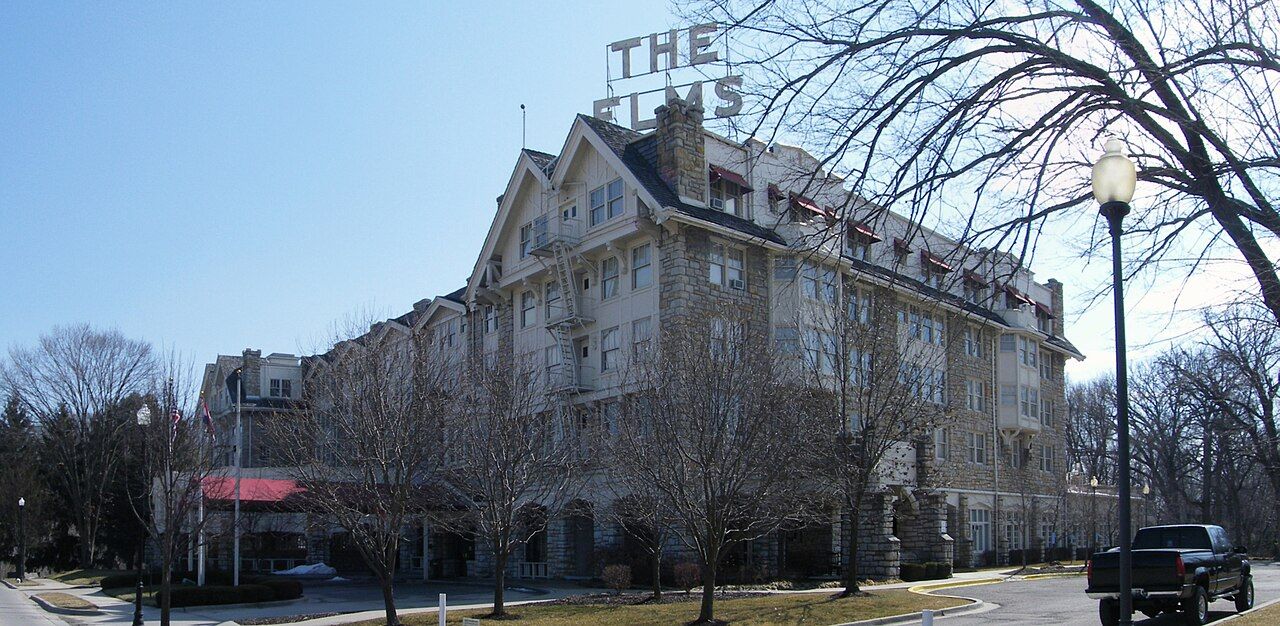
The third Elms Hotel on its site, a fireproof five-story Tudor Revival resort of stone, stucco and half-timbering opened in 1912 to serve health-seekers at Excelsior Springs' mineral wells, on grounds planned by George Kessler.
History
Excelsior Springs grew up in the 1880s around mineral wells, and its promoters knew the town needed a first-class hotel to draw well-off health-seekers. The Excelsior Springs Company set aside 23 acres and opened the first Elms on July 4, 1888: a three-story frame hotel with verandas on all four sides. It burned on May 9, 1898. New owners bought the site in 1906, brought in the Kansas City landscape architect George E. Kessler to place a larger hotel and lay out boulevards and restricted residential lots around it, and hired Louis Curtiss, later replaced by Jackson and McIlvain, as architects. The second Elms opened on July 31, 1909, and burned on October 30, 1910.
Work on a third hotel began within weeks. Investors were wary, so the town bought up the unsold lots of the Elms Addition to finance it. Built with a steel frame and reinforced concrete, the new Elms opened in 1912 with its own sulpho-saline well feeding the bath department. Jack Dempsey trained here, and Harry Truman slept here on election night in 1948, waking to the news that he had won. Prohibition-era tales of speakeasy drinking and visits by Al Capone belong to its legend.
A 1932 American Medical Association finding that mineral water had no proven benefits coincided with the hotel's bankruptcy that year. Sheraton and other chains came and went; the Elms closed in 1971 and was reopened by local investors in 1977. The city bought it in 1995 and passed it to owners who renovated it in 1998, and a second closure for renovation ended in 2012, the hotel's centennial.
“Answering to the call of civic duty, local residents bought the remaining lots in order to insure the construction of the Elms Hotel.”
Architecture
The hotel is five stories on a rough H-plan, its end wings projecting front and rear, with a two-story semicircular bay centered on each long side; the front one holds the dining room. Limestone and brick veneers cover the frame, and the upper walls carry the stucco, half-timbering and strapwork that mark the Tudor Revival. Shallow gables top the stone piers that divide the central bays, the corner wings have double gables on hipped roofs, and the main entry projects under a castellated parapet. A porte-cochere with Tudor-arched spandrels runs along the west side. Inside, the lobby has a shield-pattern tile floor, a brick front desk and a massive stone fireplace; the ballroom's beamed ceiling and larger fireplace continue the theme.
What to look for
- Half-timbered stucco panels with strapwork above stone lower walls
- Castellated entrance bay and Tudor-arched porte-cochere
- Stone lobby fireplace with arched brick inset
- The pump house and sulpho-saline well on the grounds
- Elms Boulevard's landscaped medians leading to the hotel
Setting
The Elms sits on the high north end of a nearly 15-acre park that slopes south and east to the Fishing River, at the foot of Elms Boulevard, whose planted medians Kessler designed as the hotel's approach. Stone stairs, terraced lawns and the old pump house lead down toward the river, and the Hall of Waters and downtown are a short walk away.
Timeline
- 1888First Elms Hotel opens on July 4
- 1898First hotel burns on May 9
- 1909Second Elms opens on July 31
- 1910Second hotel burns on October 30; rebuilding begins
- 1912Fireproof third Elms opens
- 1948Harry Truman spends election night at the hotel
- 1985Listed on the National Register on March 29
Where sources differ
- The 1985 nomination places the ballroom in the east wing; the 2014 district nomination places it in the southwest wing. The 1985 form calls the style Tudor/Gothic Revival and notes it follows no 'pure' style.
- Wikipedia gives the 1912 opening as September 7; the district nomination does not give a date.
- Stories of Al Capone's visits and speakeasy activity are popular lore and are not documented in the nomination.