Hotel · St. Joseph, Missouri · Built 1856–1858
Patee House
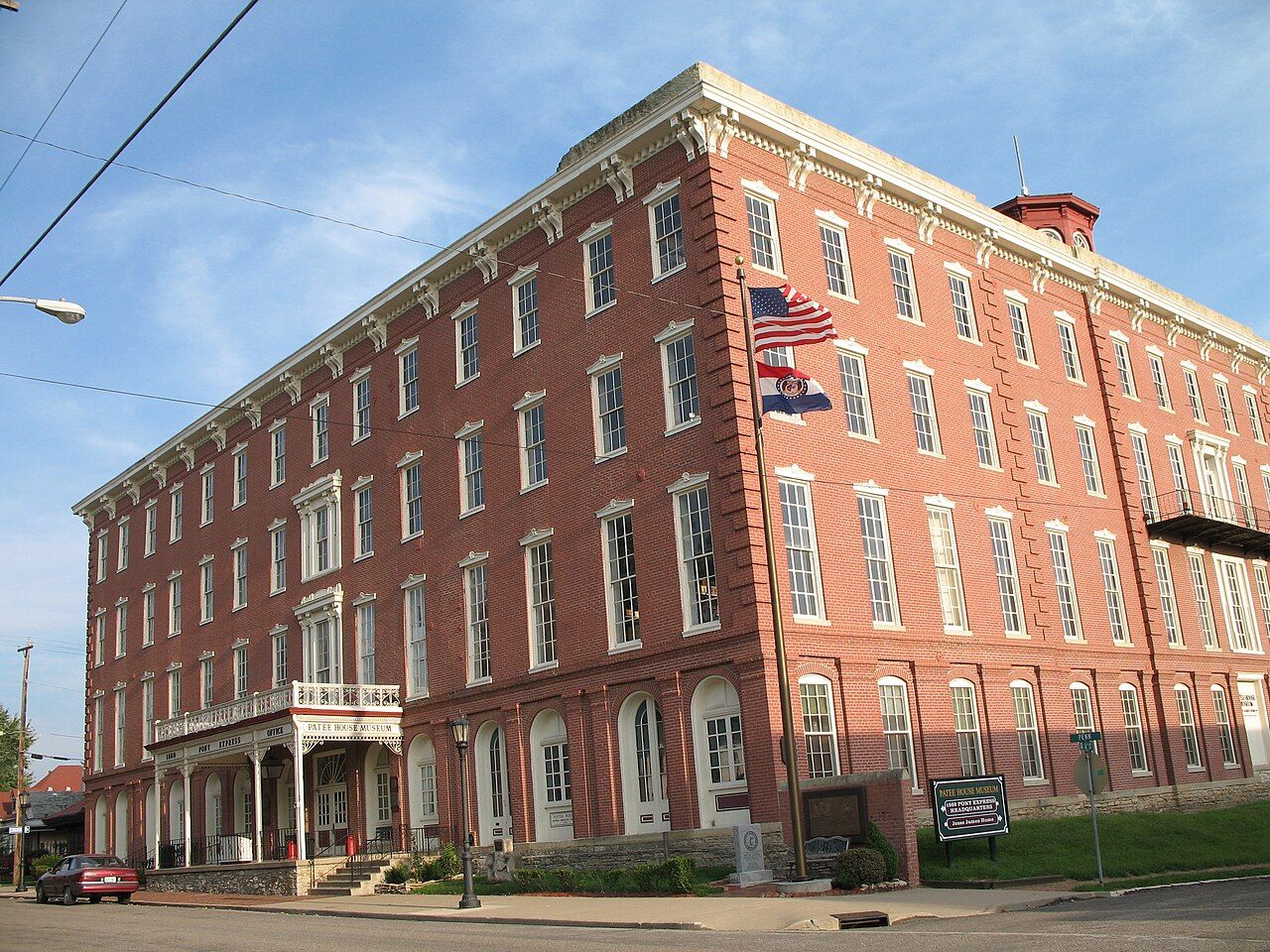
A four-story red-brick hotel of 1858 in St. Joseph that housed the Pony Express company's offices and riders in 1860; afterward a college, a shirt factory for some eighty years, and from the 1960s a museum.
History
John Patee began the hotel in 1856 at the foot of a bluff on Penn Street, as the centerpiece of a development he hoped would grow around the coming Hannibal and St. Joseph Railroad. It opened in 1858 with some 140 rooms and was reported to have cost $200,000. St. Joseph was then the jumping-off point for the overland routes, and in early 1860 the freighting firm of Russell, Majors and Waddell made the hotel the base for its new Pony Express, putting up many of the riders for the eastern half of the line. On April 3, 1860, a cannon fired in front of the building sent the first westbound rider from the stables two blocks away.
The hotel never paid well. During the Civil War the Union provost marshal and an army recruiting office occupied it, and military trials were held in the second-floor ballroom. In 1865 Patee raffled the building in a national lottery with $2 tickets, and the winning ticket, drawn on April 28, turned out to be his own. Over the next sixteen years it was a Methodist women's college, a hotel again, and a Baptist women's college. As the World's Hotel in 1882 it lodged Jesse James's family after he was shot on April 3 at his house a block north; Oscar Wilde stayed during the same month.
From 1885 the building was a shirt and overall factory, turning out millions of uniforms in both world wars. It stood empty and was vandalized after 1957 until the Pony Express Historical Association saved it in the early 1960s and opened a museum.
“Patee House was a hotel three times, a women's college twice, and a shirt and overall factory for almost 80 years, before it became a museum.”
Architecture
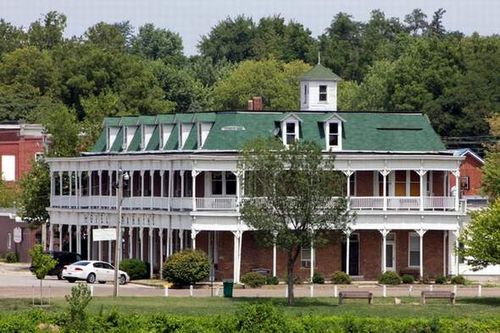
The hotel is a block-long, four-story red-brick building laid out as a U around a two-story center section enclosed on three sides. As built it had balconies, a flight of steps running the full length of the front and an ornate cupola, with steam tables in the dining room and thick red carpet throughout. Eighty years of factory use gutted much of the interior, but the second-floor ballroom, a staircase and several hotel rooms survived. The cupola was rebuilt in the mid-1970s; the long balconies and front steps were not. Industrial additions from the factory years stand on the same lot, and the large Transportation Hall inside holds an 1890s Hannibal and St. Joseph steam locomotive.
What to look for
- The rebuilt cupola on the roof
- U-shaped plan around the two-story center section
- Second-floor ballroom used for wartime trials
- Jesse James Home on the grounds
- Hannibal and St. Joseph locomotive in the Transportation Hall
Setting
Patee House fills a block at 12th and Penn streets in the Patee Town area of St. Joseph, below a bluff a short way east of downtown. The small frame house where Jesse James was killed has been moved onto the grounds, and the Pony Express National Museum, in the old stables, is two blocks west. The Missouri River flows past the town's western edge.
Timeline
- 1856John Patee begins construction
- 1858Hotel opens
- 1860Pony Express begins from in front of the hotel on April 3
- 1865Patee wins back his own hotel in a national lottery
- 1882Jesse James's family stays at the World's Hotel after his death
- 1885Building becomes a shirt factory
- 1963Pony Express Historical Association formed to save it
Where sources differ
- The nomination dates the women's colleges 1865–69 and 1875–81; Wikipedia gives 1865–68 and 1875–80.
- Sources disagree on the railroad: Wikipedia places the hotel by the Hannibal and St. Joseph station, while the 1932 history quoted in the nomination says the terminal went to Eighth and Olive instead, dooming the hotel's finances.
- The nomination names no architect and no architectural style; 'vernacular' here means only that no academic style is documented.
- Wikipedia and the nomination give the museum's start as 1963 and 1965 respectively.