Lighthouse · Richmond (offshore, near Point San Pablo), California · Built 1873–1874
East Brother Light Station
Listed on the National Register as East Brother Island Light Station
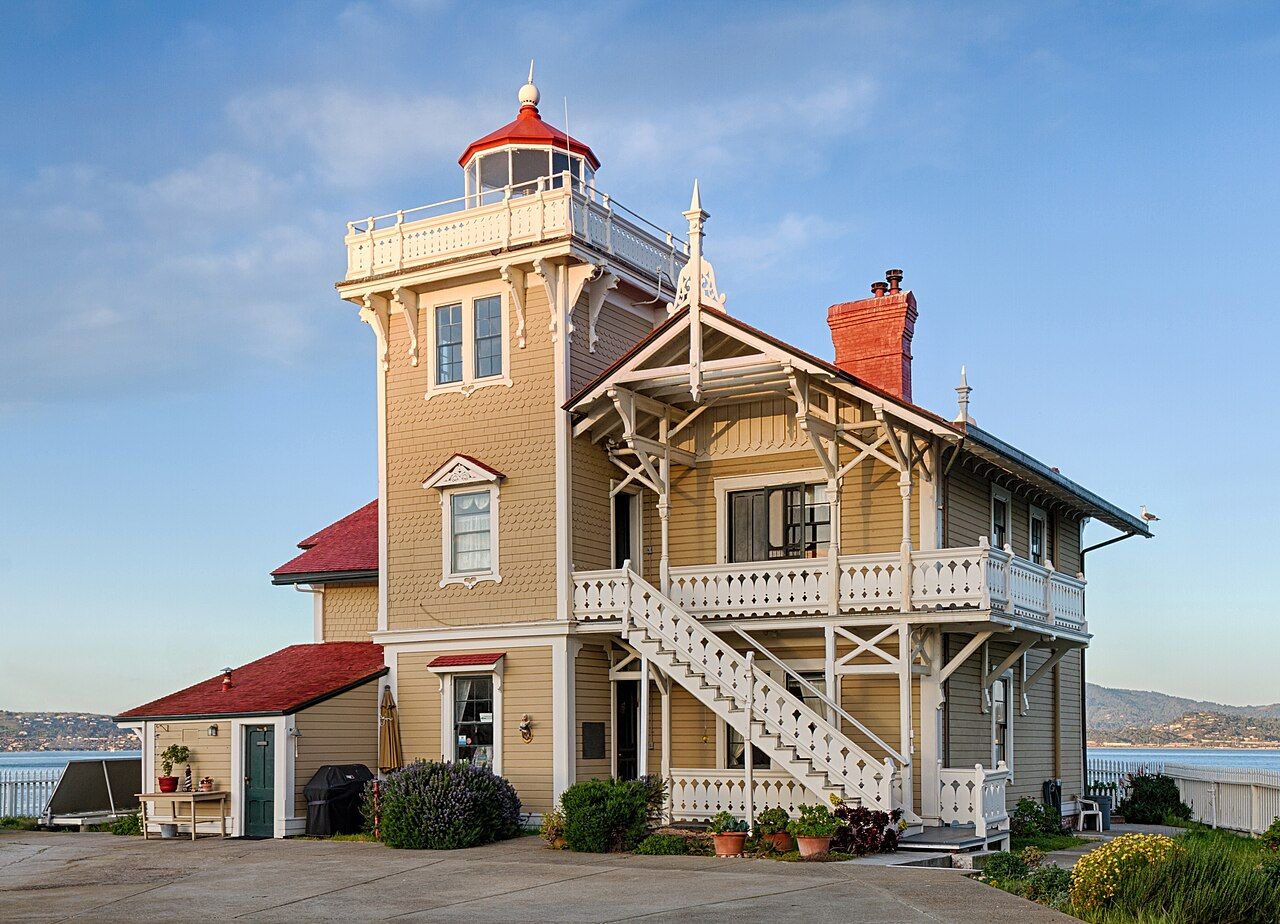
A white wooden light station of 1873–74 on a blasted-flat rock island where San Francisco Bay meets San Pablo Bay: a gabled keeper's house with attached tower, a fog signal building and a cistern; a bed-and-breakfast since 1980.
History
Ships bound up the bay to the river ports and the Mare Island navy yard had to pass the narrow strait between Point San Pablo and Point San Pedro, and the government wanted a light there. Land on the mainland was too costly, so it used the larger of the two small Brothers islands, which it already owned, and blasted the rock flat to make room. The station was built in 1873, to designs usually attributed to the Lighthouse Board draftsman Paul J. Pelz, who drew several stations in the same style, and the light was first shown on March 1, 1874. A thirty-foot cistern was cut into the rock to hold rainwater, since there was none on the island.
Keepers and their families lived in the house and hauled coal up from the landing to fire the steam fog signal. John Stenmark, a Swedish-born keeper appointed in 1894, and Willard Miller, who came in 1922, each served about twenty years; in Miller's time a fifth-order lens with an electric bulb replaced the oil lamp and a diaphone the steam signal. A fire in 1940 destroyed the wharf, boathouse and four boats. The Coast Guard, which absorbed the Lighthouse Service in 1939, automated the light in 1969 and proposed tearing down the buildings, but protests saved them and the station was listed on the National Register in 1971. A nonprofit formed in 1979 restored it with grants and volunteer labor, and opened the keeper's house as a bed-and-breakfast in 1980.
“Sturdily set on the larger of the two small, rocky Brothers Islands (which are located off-shore west of Point San Pablo, at the juncture of the San Francisco and San Pablo Bays)”
Architecture
The keeper's house is a two-story white wooden building with steep gables and sawn ornament, joined to a short square light tower, a modest example of what the nomination calls Carpenter Gothic and Wikipedia calls the Stick style. Around it on the island stand the fog signal building, a combined shop and storage building, a round water tank and the large domed cistern, all enclosed by the original low white picket fence. The nomination, written in 1971, found the main building essentially original apart from asphalt shingles, added bathrooms and modern kitchens. Seen from shore, the cluster of white buildings on its rock reads at a glance as a nineteenth-century light station.
What to look for
- Gabled keeper's house with attached square tower
- The fog signal building near the landing
- Domed rainwater cistern cut into the rock
- Original low white picket fence
- Views of the Richmond–San Rafael Bridge
Setting
The station occupies the larger of The Brothers, two small rocky islands just off Point San Pablo in Richmond, at the strait joining San Francisco and San Pablo bays. The Richmond–San Rafael Bridge crosses the water to the south, and Mount Tamalpais rises across the bay. The island is reached only by boat from the Point San Pablo harbor.
Timeline
- 1873Island leveled and station built
- 1874Light first shown on March 1
- 1894John Stenmark appointed keeper
- 1940Fire destroys the wharf and boathouse
- 1969Light automated
- 1971Listed on the National Register
- 1980Keeper's house opens as a bed-and-breakfast
Where sources differ
- The nomination does not name the designer, describing him only as an East Coast lighthouse designer; the attribution to Paul J. Pelz comes from Wikipedia.
- The nomination dates construction to 1873; the light was first lit on March 1, 1874, per Wikipedia.
- The nomination calls the style Carpenter Gothic and Wikipedia calls it Stick style; gothic-revival is used here.