Inn · Petrified Forest National Park, Arizona · Built 1937–1940, rebuilt from a 1920s lodge; redecorated 1947–1948
Painted Desert Inn
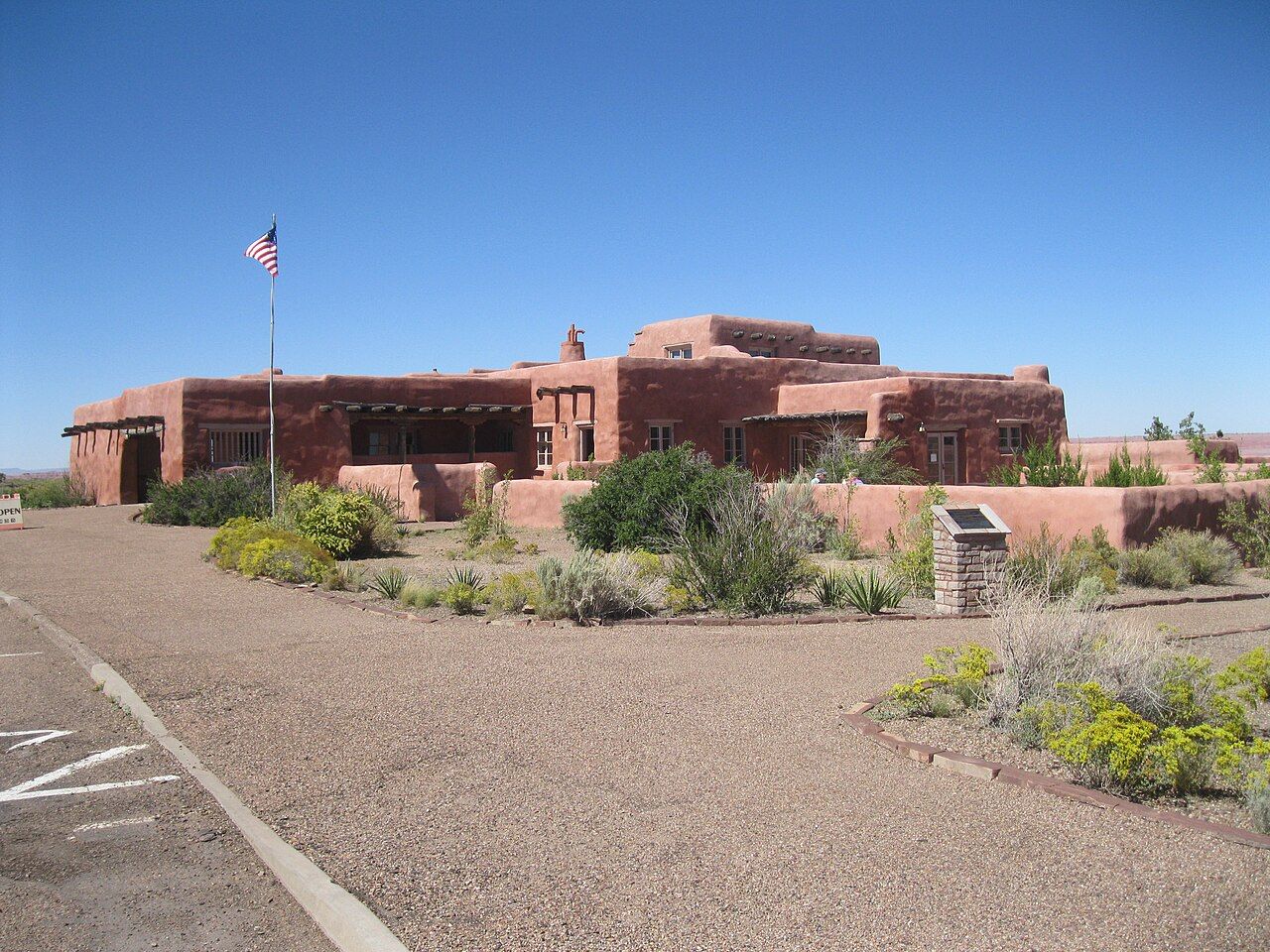
A Pueblo Revival inn and trading post on a mesa above the Painted Desert, rebuilt by the CCC in 1937–40 to Lyle Bennett's designs and later decorated for Fred Harvey by Mary Colter, with murals by Hopi artist Fred Kabotie.
History
In the 1920s a private trading post known as the Stone Tree House stood on this rim, built of stone and some petrified wood in mud mortar, without water or electricity. The National Park Service bought it in 1936 with Works Progress Administration money, but the bentonite clay beneath was already cracking the walls. New construction was hard to fund and rebuilding was not, so the Park Service treated the project as a rebuilding. When contractors' bids came in too high, it bought the materials itself and used labor from the Civilian Conservation Corps camp at Rainbow Forest. Ponderosa pine came from the Sitgreaves National Forest and aspen from the White Mountain Apache reservation, both cut under the label of forest thinning. Under supervising architect Lorimer Skidmore, the crews shored up some old walls and rebuilt others, and taught masons to round the door and window openings like hand-plastered pueblo adobe.
The inn opened in July 1940 with a lunchroom, dining room, trading post and six guest rooms with corner fireplaces, closed during the Second World War, and reopened in 1946. The Fred Harvey Company took over soon after, and in 1947 Mary Colter recolored the interiors and commissioned Fred Kabotie to paint murals of Hopi life, among them the young men's journey to the Zuni salt lake. Harvey ran the inn until 1963, after which it served intermittently as a museum and meeting hall. Proposed for demolition in the 1970s, it was saved by protest, reopened as a Bicentennial travel center in 1976, designated a National Historic Landmark in 1987, and restored as a museum, most recently in 2004–06.
“The building's importance lies in its artistic design which permeated the exterior but was brought to its highest level on the interior.”
Architecture
The inn banks into the mesa on several levels, its stone walls more than two feet thick under pink earth-toned stucco, with flat parapeted roofs, canales and projecting viga ends that throw shadows across the walls. Flagstone terraces with low walls overlook the desert. Inside, ponderosa vigas rest on posts with carved and painted Spanish Colonial corbels, under split aspen savinos. Bennett's details carry the design: concrete floors scored and tinted in Navajo blanket patterns, a large skylight in the Trading Post room with prehistoric pottery designs painted on its panes, punched-tin chandeliers, sandblasted doors and frames to look old, and radiators hidden behind carved grilles. Kabotie's murals fill the former dining room and coffee shop.
What to look for
- Fred Kabotie's Hopi murals
- The painted pottery-design skylight in the Trading Post room
- Concrete floors scored in blanket patterns
- Rounded, hand-shaped door and window openings
- Carved corbels and aspen savino ceilings
Setting
The inn stands at Kachina Point on the rim of a mesa in the northern part of Petrified Forest National Park, overlooking the banded badlands of the Painted Desert. The park road and the old alignment of Route 66 pass nearby, and a rim trail leads along the edge in both directions.
Timeline
- 1920sStone Tree House trading post built on the site
- 1936National Park Service acquires the building
- 1937–1940CCC rebuilds it as the Painted Desert Inn
- 1940Inn opens in July
- 1947–1948Mary Colter redecorates; Fred Kabotie paints murals
- 1963Fred Harvey operation ends and the inn closes
- 1987Designated a National Historic Landmark
Where sources differ
- Wikipedia says overnight lodging ended in 1947, while the nomination says the Fred Harvey Company ran the inn until 1963 without saying when the guest rooms stopped being let.
- The original National Register listing year (1975) is inferred from the nomination's reference to an existing listing; the 1987 date is the Landmark designation.
- The nomination's suggestion that these were among Kabotie's last murals is speculative.