Inn · Castroville, Texas · Built c. 1849–1850; enlarged c. 1854 and later
Landmark Inn
Listed on the National Register as Landmark Inn Complex
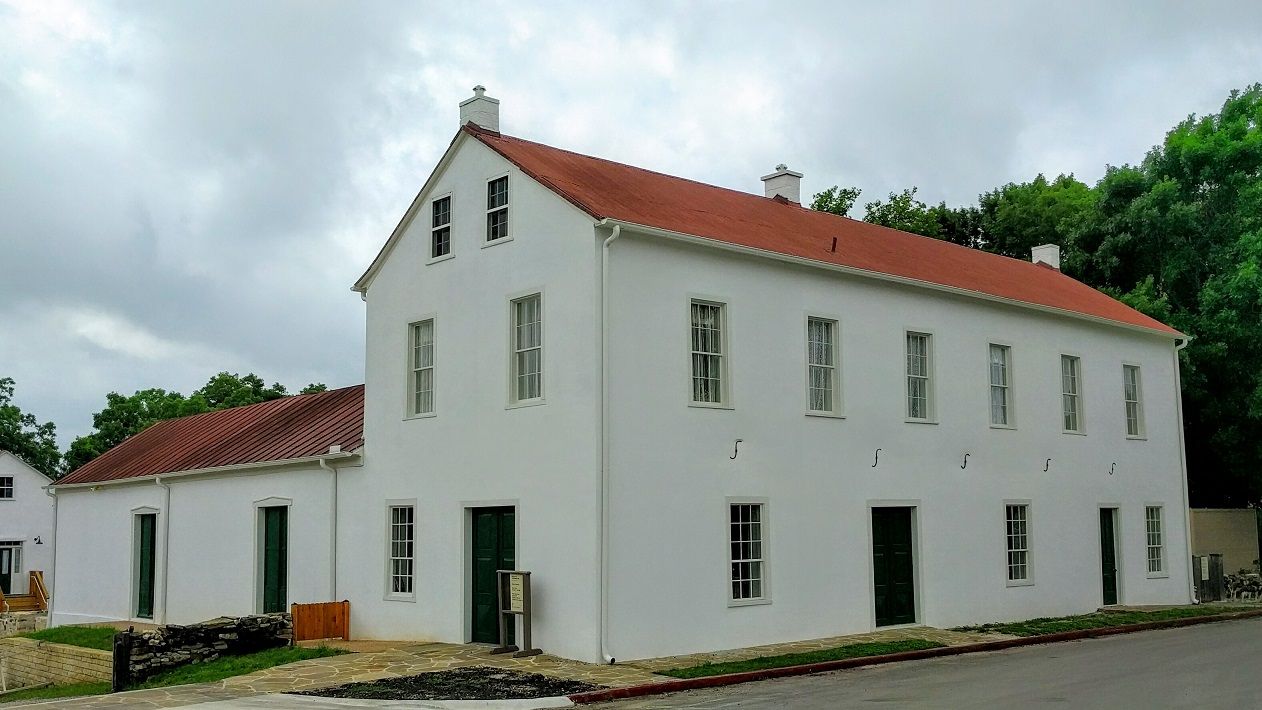
Whitewashed limestone buildings by the Medina River in the Alsatian colony town of Castroville: a store of about 1850 that John Vance enlarged into a hotel for travelers to Mexico, with a bathhouse and gristmill.
History
Henri Castro brought shiploads of colonists from the Rhine Valley to found Castroville in 1844, and the town kept its Alsatian look of plain stuccoed stone houses. Cesar Monod, a French settler and later mayor, bought this lot from Castro in 1849 and the next one from Michel Simon in 1850, and built a one-story stone house and store with a separate kitchen above a busy crossing of the Medina River. In February 1853 John Vance, a New York-born merchant who had traded in Little Rock and San Antonio, bought the property for $3,500. He raised the store to two stories, added a double gallery, a long store wing and outbuildings, and ran it as both store and inn. The Vance Hotel became a regular stop on the road between San Antonio and Mexico; its stone bathhouse was a rare luxury, and tradition says the lead lining of its tank was melted for Confederate bullets. Vance also served as postmaster from 1867 to 1878, with the post office in the corner room.
Behind the hotel, G.L. Haass and Laurent Quintle built a dam, millrace and two-story stone gristmill in the 1850s. The Vance heirs sold in 1899 to the Courand family, millers who let the hotel decline. A Lawler family member bought the property in 1925 and turned the mill into the plant that gave Castroville its first electricity in 1927. On July 4, 1942, the old hotel reopened as the Landmark Inn, largely for servicemen moving between San Antonio and Hondo air bases. Ruth Lawler donated it to the state in 1974, and it opened as a state historic site with guest rooms in 1981.
“Part of the hotel's renown came from an unusual feature for the time and place - a stone bath house, located in the courtyard.”
Architecture
The buildings are cut limestone laid in adobe-type mortar and coated inside and out with whitewashed lime plaster, the walls eighteen to twenty-four inches thick. The hotel's two-story main block, built on Monod's one-story house, stands nearly flush with Florence and Florella Streets, with six chambers upstairs reached by an outside stair in an inset double gallery on the courtyard side. Its sixty-foot one-story store wing has French doors under a simple Greek Revival entablature with a shallow pediment. Nearby are the detached stone kitchen, the two-story bathhouse with exterior stair and balcony, Vance's one-and-a-half-story house on a raised basement with matching pilastered doorways front and back, and by the river the plain two-story stone mill with its underground millrace.
What to look for
- Whitewashed lime plaster over thick limestone walls
- Exterior stair in the inset double gallery
- Two-story stone bathhouse in the courtyard
- Stone gristmill and dam on the Medina River
- Greek Revival doorway on the store wing
Setting
The inn stands at the southeast corner of Florence and Florella Streets at the east end of Castroville, half a block from U.S. 90 and close to the Medina River bridge, about 25 miles west of San Antonio. The mill, dam and millrace lie behind it on the riverbank. The surrounding historic district preserves the town's small, widely spaced Alsatian stone houses and churches.
Timeline
- 1844Henri Castro's colonists found Castroville
- 1849Cesar Monod buys the lot and builds a stone house and store
- 1853John Vance buys the property and expands it as the Vance Hotel
- 1850sHaass and Quintle build the dam and gristmill
- 1927Mill begins supplying Castroville's first electricity
- 1942Reopened as the Landmark Inn on July 4
- 1981Opened as a state historic site
Where sources differ
- The nomination dates Vance's second story to about 1854; Wikipedia dates it to 1874.
- The 1925 purchaser is called John T. Lawler in the nomination and Jordan T. Lawler by Wikipedia.
- The melting of the bathhouse's lead lining for Confederate bullets is tradition.