Hotel · Georgetown, Colorado · Built 1875; enlarged 1878–1889
Hotel de Paris
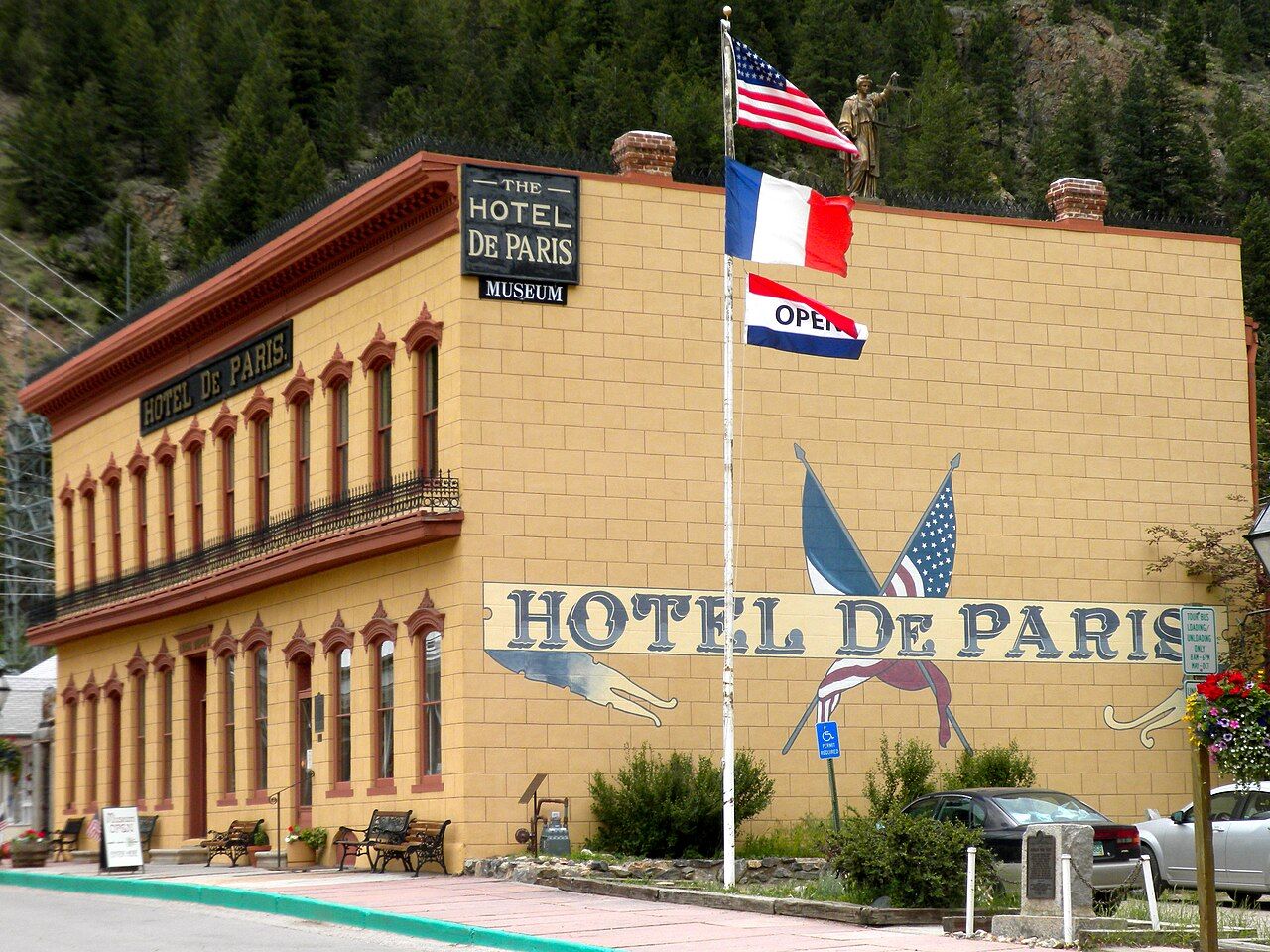
A stuccoed two-story hotel in the silver town of Georgetown, made from a bakery by the French cook Louis Dupuy, who opened it in 1875 and enlarged it until 1889; a museum of the Colonial Dames since 1954.
History
Louis Dupuy was born Adolphe François Gérard in Alençon, Normandy, in 1844. He trained briefly for the priesthood and then as a cook, came to the United States in 1866, enlisted in the Army and deserted in 1869, taking a new name. He worked as a mining reporter and then a miner in Georgetown until a blast near Silver Plume injured him in 1873. Neighbors raised money to set him up in the Delmonico Bakery on Alpine Street, which he turned into a small hotel and restaurant, the Hotel de Paris, opened on October 9, 1875.
Georgetown was a silver boom town, and after the Colorado Central Railroad arrived in 1877 Dupuy prospered. He built additions in 1878, 1881–82 and 1889, doing much of the work himself, and with the last he covered the whole front in stucco scored to look like cut stone. Rooms had washbasins with hot and cold water; gas light gave way to electricity in 1893. Dupuy cooked, kept a cellar of imported wines drawn from bulk casks but never ran a bar, lent books from a library of some 2,500 volumes in four languages, and set aside sample rooms where traveling salesmen showed their goods. Jay Gould, William Henry Jackson and Isabella Bird were among the guests. The 1893 silver crash ended Georgetown's prosperity. Dupuy died of pneumonia in October 1900, leaving the hotel to his housekeeper, Sophie Gally. Sarah Burkholder bought it in 1903, and her family kept it, for a time as a boarding house, until the Colonial Dames bought it in 1954 and opened a museum.
“The Hotel de Paris became a bit of France relocated to the Rockies.”
Architecture
The hotel is two stories of masonry under stucco, its first-floor walls three feet thick, with a facade the nomination describes as French in the manner of a provincial hotel. A classical statue stands on the roof, French and American flags are painted on the wall, and a zinc lion and stag guard the gateposts beside the building. Behind lies a walled courtyard with more rooms. The first floor held six large rooms, including the kitchen with the old bakery oven and a dining room floored in alternating maple and walnut; the second floor had ten bedrooms. Below is the wine cellar with Dupuy's bottling equipment. Most of the furnishings, including Dupuy's books and Haviland china, are original.
What to look for
- Stucco facade scored to imitate ashlar
- Rooftop statue and painted flags
- Zinc lion and stag on the gate portals
- Maple and walnut dining-room floor
- Bakery oven and wine cellar
Setting
The hotel faces Alpine (6th) Street at the east end of Georgetown, across from the town hall, in a narrow valley of Clear Creek just off Interstate 70 about 45 miles west of Denver. The town's Victorian commercial blocks and houses make up a National Historic Landmark district, and the Georgetown Loop Railroad runs up the valley toward Silver Plume.
Timeline
- 1875Louis Dupuy opens the Hotel de Paris on October 9
- 1877Colorado Central Railroad reaches Georgetown
- 1889Final addition and new stuccoed facade
- 1893Electric lighting installed; silver crash
- 1900Dupuy dies of pneumonia
- 1954Colonial Dames buy the hotel and open a museum
- 1970Listed on the National Register
Where sources differ
- The nomination says Dupuy bought the Delmonico Bakery; Wikipedia says townspeople's donations let him rent it.
- The nomination says Mrs. Burkholder ran the hotel until her death in 1932; Wikipedia says the family kept it until 1954. The nomination calls the rooftop figure a statue of Liberty; other accounts identify it as Justice.
- The nomination's description of Dupuy as the 'Father of Domestic Science' rests on an anecdote and is not established.
- The nomination names no academic style; the French provincial facade does not fit the site's style keys, so 'vernacular' is used.