Mansion · Lakewood, Washington · Built 1909–1911
Thornewood Castle
Listed on the National Register as Thornewood
A red-brick Tudor Gothic manor house of 1909–11 on American Lake south of Tacoma, designed by Kirtland Cutter for financier Chester Thorne with Olmsted Brothers gardens; later divided into apartments and opened to overnight guests.
History
Chester Thorne, a New Yorker and Yale graduate, came to Tacoma in 1890 to run the National Bank of Commerce and kept it solvent through the panic of 1893, one of the few local banks that survived. He went on to finance shipping, cold storage, gypsum and lumber concerns, helped organize the Rainier National Park Company and Fort Lewis, and chaired the Tacoma port commission from 1920 to 1927, earning the title 'Father of the Port of Tacoma'. Between 1909 and 1911 he and his wife Anna built a hundred-acre country estate on the southeast shore of American Lake. The Spokane architect Kirtland Cutter designed a manor house, gatehouse and carriage house in an English Tudor Gothic manner, while the Olmsted Brothers laid out formal garden rooms and lawns framing Mount Rainier.
The Thornes moved in in 1911. Their gardens, opened freely to the public, won national praise; the Garden Club of America, visiting in 1930, called them 'simple perfection'. Presidents are said to have stayed, though the sources disagree on which. After Anna Thorne died in 1957 the estate was sold and subdivided for houses, and most of the gardens were lost. The manor kept about three acres and was divided into six apartments, later serving as a bed-and-breakfast. The three Cutter buildings, on separate parcels, were listed on the National Register in 1982. Around 2000 the manor's use as the set for the miniseries Rose Red helped pay for restoring the house and its sunken garden, and it later opened as a hotel and event venue.
“Together they represent an unusual architectural assemblage, a rare example of an early 20th century English manor in the Pacific Northwest.”
Architecture
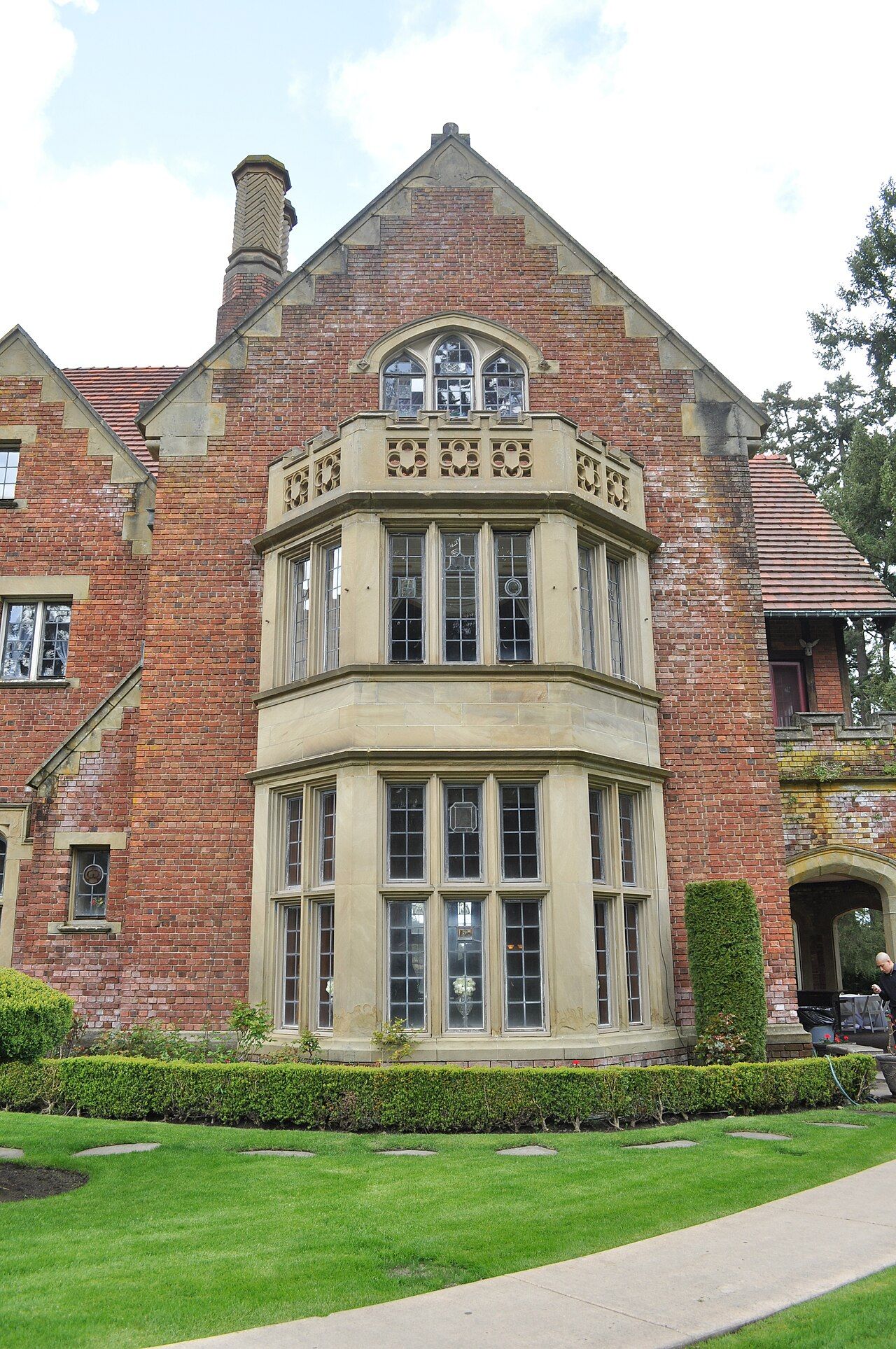
The manor is a two-and-a-half-story red-brick rectangle under a steep red tile roof broken by three large cross gables on each long front, the end gables half-timbered. Crenellated parapets and sandstone set stepwise into each gable tie the long facades together, and ornate chimneys rise above, one a clustered Jacobean stack, the others paired with tall terra-cotta pots. Door and window surrounds, mullions and the faces of oriels and bays are local Wilkeson sandstone. Every window is leaded, and set into them are period stained and painted glass medallions Thorne bought in England. The house has about forty rooms. The brick gatehouse repeats the design in miniature, and the carriage house shows the most half-timbering.
What to look for
- Crenellated parapets and stepped sandstone gables
- The clustered Jacobean chimney
- Stained-glass medallions in the leaded windows
- The sunken garden toward American Lake
- The brick gatehouse on North Thorne Lane
Setting
The manor stands on the southeast shore of American Lake in Lakewood, in the lake district south of Tacoma, now inside a gated neighborhood built on the old estate. Lawns slope west to the water, and the eastern approach looks toward Mount Rainier. The surviving sunken garden lies between house and lake; the gatehouse and carriage house stand on separate private lots.
Timeline
- 1890Chester Thorne arrives in Tacoma
- 1909Construction begins on American Lake
- 1911The Thornes move into Thornewood
- 1930Garden Club of America praises the gardens
- 1957Anna Thorne dies; estate sold and subdivided
- 1982Manor, gatehouse and carriage house listed on the National Register
- 2000Filming of Rose Red funds restoration
Where sources differ
- Wikipedia says the oak staircase, paneling and doors came from a dismantled fifteenth-century English manor and that the brick was made in Wales; the nomination mentions only stained glass bought in England.
- The nomination names Theodore Roosevelt and Warren G. Harding as guests; Wikipedia names Roosevelt and William Howard Taft and questions the dates.
- The sources do not say when the house first took paying overnight guests.