Lodge · Mount Rainier National Park (Paradise), Washington · Built 1916–1917; annex 1920; lobby mezzanine 1925
Paradise Inn
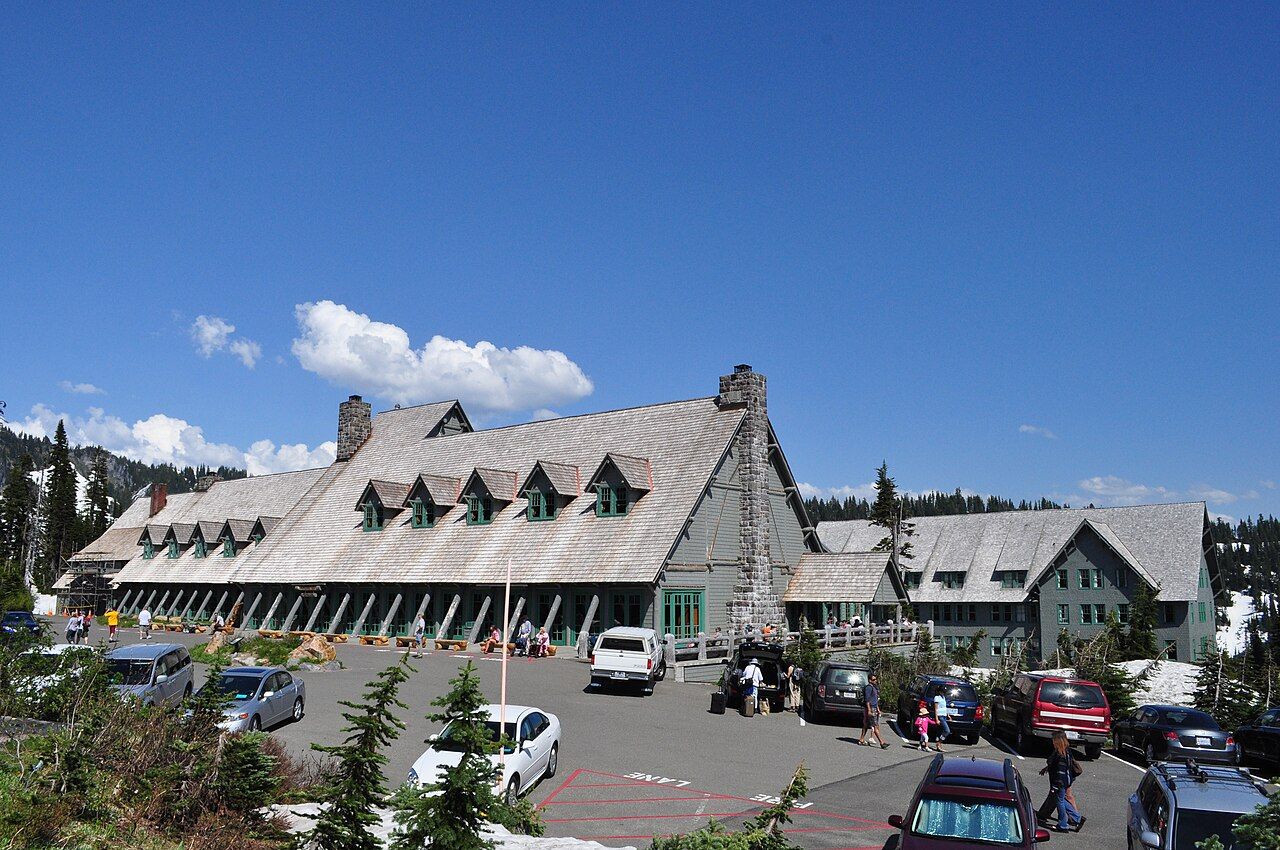
A steep-roofed inn of 1916–17 at 5,400 feet on Mount Rainier, framed in silvery fire-killed Alaska cedar and built by a Seattle–Tacoma company that Stephen Mather urged to form; its log lobby rises under the great gables.
History
Paradise valley, on Mount Rainier's south slope, had drawn climbers and campers since the nineteenth century, served by makeshift tent hotels. Stephen Mather, soon to head the new National Park Service, wanted one well-capitalized concessioner per park and better buildings; he warned Seattle and Tacoma businessmen that if they did not form a company, Eastern interests would. In 1916 they organized the Rainier National Park Company. A hotel had first been planned at Longmire, but company members hiked up from the end of the new road to a rise with views of the summit and the Tatoosh Range and chose to build there. The Tacoma firm of Heath, Gove and Bell designed the inn using Alaska cedar from a stand killed by fire decades earlier, its weathered trunks gone silver. The Park Service vetoed a red roof in favor of green. The inn opened on July 1, 1917, at a cost of $90,000 to $100,000.
A four-story annex designed by Harlan Thomas added about a hundred rooms in 1920, and the lobby mezzanine came in 1925. Paradise became an early ski resort; competitors in the 1934–35 Olympic tryouts stayed here, and Army troops trained for winter warfare in 1942–43. Harry Truman played the lobby piano in 1945. The struggling company sold the inn to the Park Service in 1952. Demolition was considered, but the building was strengthened in 1979–80, named a National Historic Landmark in 1987, and closed from 2006 to 2008 for seismic work.
“The most dominant characteristic of the building is the series of massive gable roofs that make up more than two-thirds the height of the building's main wing.”
Architecture
The inn is T-shaped, two and a half stories on a rubble masonry base, its massive cedar-shingled gable roofs making up more than two-thirds of the main wing's height and pierced by dormers. Fourteen equal glazed bays across the front open in fair weather, separated by inclined columns, steel T-beams hidden inside hollowed logs, that replaced the original log braces. Inside, the lobby is a forest of exposed silver cedar posts, beams and trusses, some wrapped with cable and iron to keep them from splitting under snow, with stone fireplaces at both ends, a log-railed mezzanine and posts painted with evergreen patterns; the dining room posts carry Swiss floral designs. Hand-built log furniture, including a grandfather clock and a piano attributed to Hans Fraehnke, remains in the lobby.
What to look for
- The great green-painted shingle roofs and dormers
- Silver Alaska cedar posts and trusses in the lobby
- Painted designs on the lobby and dining room posts
- Fraehnke's grandfather clock and log piano
- Fourteen glazed bays across the front
Setting
The inn stands at about 5,400 feet in the subalpine meadows of Paradise, with the summit of Mount Rainier rising directly above and the Tatoosh Range across the valley. The 1920 Guide House and the modern Jackson Visitor Center are nearby, and trails such as the Skyline Trail climb from the parking lot into wildflower meadows and toward the glaciers.
Timeline
- 1916Rainier National Park Company formed; construction begins
- 1917Paradise Inn opens on July 1
- 1920Four-story annex added
- 1925Lobby mezzanine built
- 1952Sold to the National Park Service
- 1987Designated a National Historic Landmark on May 28
- 2006–2008Closed for seismic strengthening
Where sources differ
- Wikipedia says Mather founded the company; the nomination says he persuaded local businessmen to form it.
- The nomination notes that almost nothing is documented about the woodcrafter beyond his name; stories of such itinerant craftsmen are largely oral tradition.
- Wikipedia dates the fire that killed the cedar to 1885 and the original plan's location to Longmire; neither is in the nomination.